
On December 29, 2021, the Expert Lecture Series of the "Buddhism and Psychotherapy" research project, organized by the Center for Buddhist Studies at Fo Guang University, was held at Yunshuixuan. Prof. Lu Chien-Chi, President of the Taiwan Society for Philosophical Counseling, presented on the topic "The First Encounter between Buddhism and Philosophical Counseling." The session was moderated by Prof. Guo Chao-Shun, General Director of the research project and Dean of the College of Buddhist Studies. Approximately 40 faculty members and students attended, hailing from the Department of Buddhist Studies, Department of Psychology, Graduate Institute of Religious Studies, Department of History, and the Language Center, as well as guests from outside the university.
In his introduction, Prof. Guo noted that Prof. Lu has dedicated many years to the helping professions, promoting philosophical counseling education and introducing philosophical counselor training systems from abroad. Following the previous lecture's dialogue with psychological counseling, today marked the initial dialogue with philosophical counseling. The aim was to explore the path of "Buddhist Philosophical Counseling" and to expand students' horizons regarding helping professions.
Prof. Lu first discussed the "Theories and Methods of Philosophical Counseling." He cited the PEACE process proposed by Lou Marinoff in Plato Not Prozac! as a pioneering method. Additionally, he mentioned theories by Peter B. Raabe, Gerd B. Achenbach, Shlomit C. Schuster, Elliot D. Cohen, and Oscar Brenifier, as well as the C.I.S.A method developed by Li Jian-Qiu.
Summarizing the "Basic Principles of Philosophical Counseling," Prof. Lu included: viewing the person seeking counseling as a "client" rather than a patient; establishing a non-medical relationship with the counselor; maintaining a relationship free from hierarchical value judgments; allowing the client to undergo a transformation and transcendence of values; exploring more fundamental issues such as the axiological or ontological self to resolve immediate, individual problems; and emphasizing listening while focusing on the logical thinking issues that cause the client's various predicaments.
Next, he described the establishment and development of the Taiwan Society for Philosophical Counseling, the training content for philosophical counselors, and the current status of philosophical counseling courses offered in Taiwan's colleges and universities.
Finally, he posed questions regarding "Buddhism and Philosophical Counseling," such as: Counseling is a helping profession in the form of dialogue aimed at resolving issues arising from birth, old age, sickness, and death; how does it differ from or resemble Buddhism? If Buddhism is to conduct counseling, it is necessary to clarify its theoretical basis, counseling methods, problems to be solved, target audience, and objectives.
During the exchange, Chair Lin Wei-Lun of the Department of Psychology asked how philosophical counseling applies to clients with difficulties in logical thinking. He also noted that counseling relies heavily on language, while Buddhist practice tends to seek liberation from suffering by transcending language (ineffability); how can the two sides dialogue? Furthermore, would Buddhist counseling use Gong-an (Koan) stories to enlighten the client rather than necessarily focusing on the client's specific problems?
In response, Prof. Lu argued that all humans operate on their own hypothetical propositions but often get trapped in erroneous reasoning; only by helping them transform these thoughts is there a chance to change behavior. Regarding counseling and Buddhist practice, Prof. Guo mentioned that the two can be integrated. That is, using counseling techniques to dialogue with the client and introducing different practice methods—such as repentance rituals or meditation—during the process to address specific problems could help construct a theory of Buddhist counseling. As for the language of Gong-ans, it is concise and primarily effective in cutting off thoughts. Finally, Prof. Guo explained that the methods of philosophical counseling can serve as a reference for Buddhist education, which is also one of the goals of the Center's interdisciplinary project promotion.
In his introduction, Prof. Guo noted that Prof. Lu has dedicated many years to the helping professions, promoting philosophical counseling education and introducing philosophical counselor training systems from abroad. Following the previous lecture's dialogue with psychological counseling, today marked the initial dialogue with philosophical counseling. The aim was to explore the path of "Buddhist Philosophical Counseling" and to expand students' horizons regarding helping professions.
Prof. Lu first discussed the "Theories and Methods of Philosophical Counseling." He cited the PEACE process proposed by Lou Marinoff in Plato Not Prozac! as a pioneering method. Additionally, he mentioned theories by Peter B. Raabe, Gerd B. Achenbach, Shlomit C. Schuster, Elliot D. Cohen, and Oscar Brenifier, as well as the C.I.S.A method developed by Li Jian-Qiu.
Summarizing the "Basic Principles of Philosophical Counseling," Prof. Lu included: viewing the person seeking counseling as a "client" rather than a patient; establishing a non-medical relationship with the counselor; maintaining a relationship free from hierarchical value judgments; allowing the client to undergo a transformation and transcendence of values; exploring more fundamental issues such as the axiological or ontological self to resolve immediate, individual problems; and emphasizing listening while focusing on the logical thinking issues that cause the client's various predicaments.
Next, he described the establishment and development of the Taiwan Society for Philosophical Counseling, the training content for philosophical counselors, and the current status of philosophical counseling courses offered in Taiwan's colleges and universities.
Finally, he posed questions regarding "Buddhism and Philosophical Counseling," such as: Counseling is a helping profession in the form of dialogue aimed at resolving issues arising from birth, old age, sickness, and death; how does it differ from or resemble Buddhism? If Buddhism is to conduct counseling, it is necessary to clarify its theoretical basis, counseling methods, problems to be solved, target audience, and objectives.
During the exchange, Chair Lin Wei-Lun of the Department of Psychology asked how philosophical counseling applies to clients with difficulties in logical thinking. He also noted that counseling relies heavily on language, while Buddhist practice tends to seek liberation from suffering by transcending language (ineffability); how can the two sides dialogue? Furthermore, would Buddhist counseling use Gong-an (Koan) stories to enlighten the client rather than necessarily focusing on the client's specific problems?
In response, Prof. Lu argued that all humans operate on their own hypothetical propositions but often get trapped in erroneous reasoning; only by helping them transform these thoughts is there a chance to change behavior. Regarding counseling and Buddhist practice, Prof. Guo mentioned that the two can be integrated. That is, using counseling techniques to dialogue with the client and introducing different practice methods—such as repentance rituals or meditation—during the process to address specific problems could help construct a theory of Buddhist counseling. As for the language of Gong-ans, it is concise and primarily effective in cutting off thoughts. Finally, Prof. Guo explained that the methods of philosophical counseling can serve as a reference for Buddhist education, which is also one of the goals of the Center's interdisciplinary project promotion.
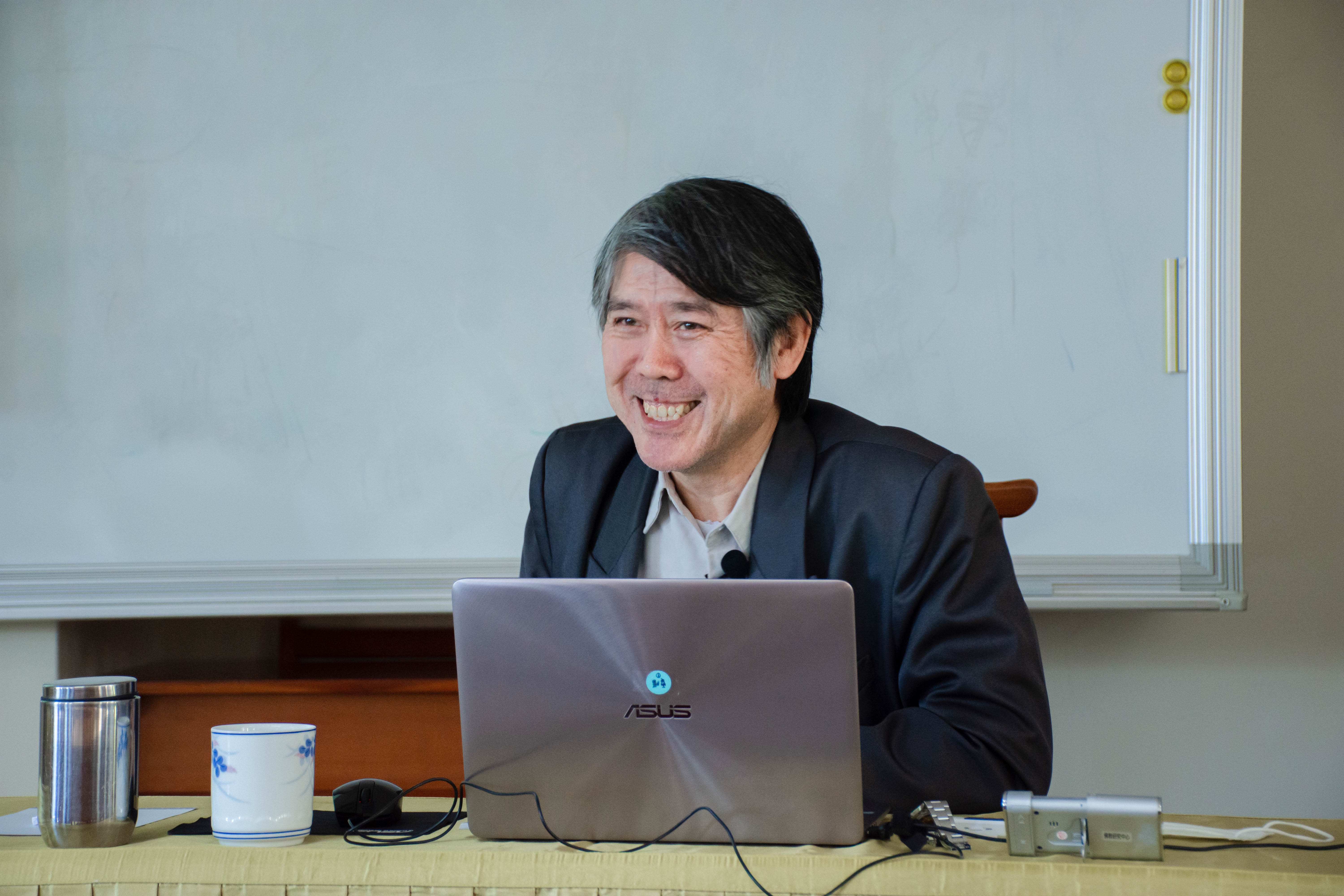
Prof. Lu Chien-Chi, President of the Taiwan Society for Philosophical Counseling, presenting on "The First Encounter between Buddhism and Philosophical Counseling."
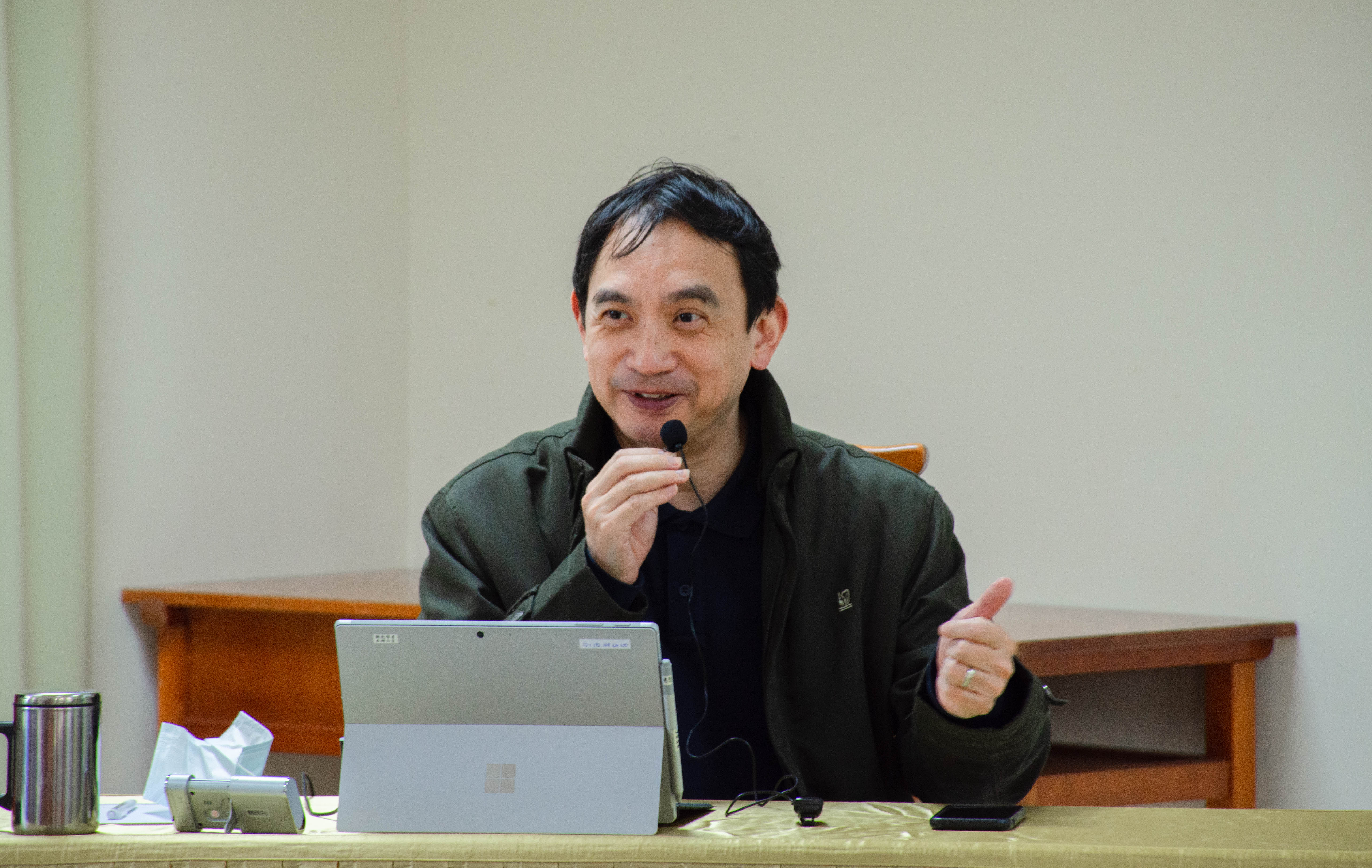
Prof. Guo mentioned that this lecture aimed to expand students' horizons regarding helping professions.

After the lecture, Chair Lin Wei-Lun of the Department of Psychology engaged in a lively exchange with the speaker.

The topic attracted faculty and students from various departments within and outside the university.
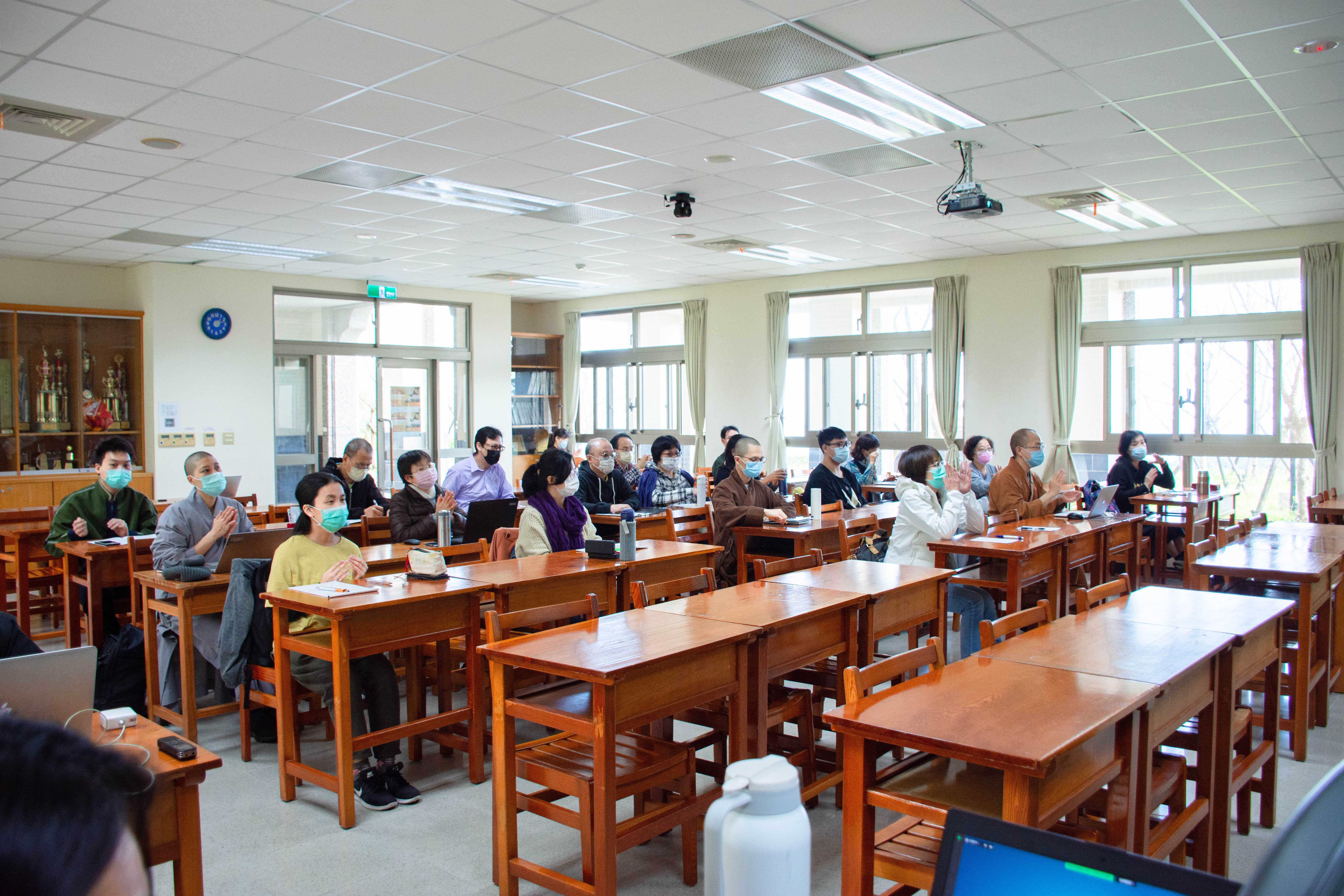
A scene from the lecture.
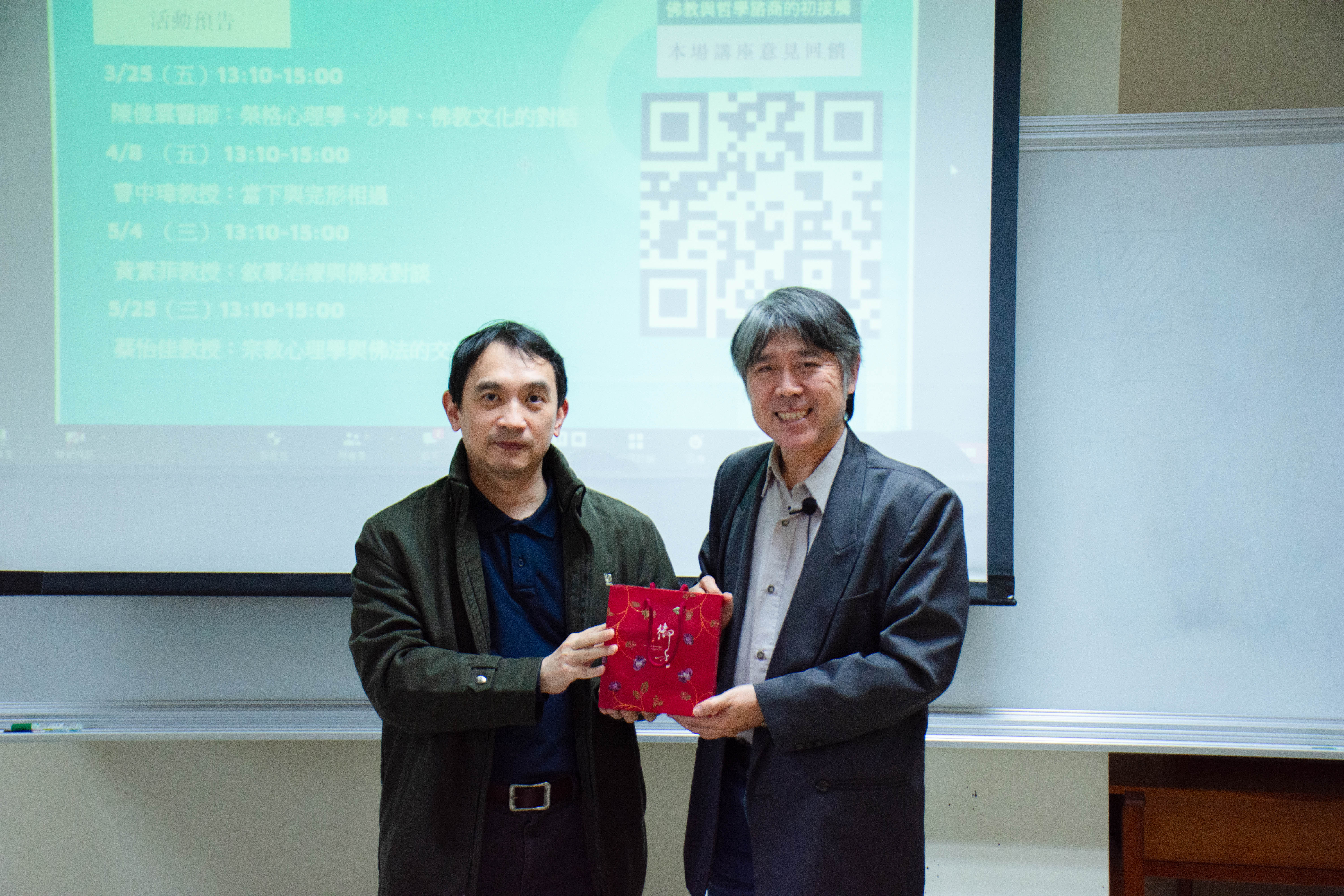
At the conclusion of the lecture, Prof. Guo presented a gift to Prof. Lu as a token of appreciation.