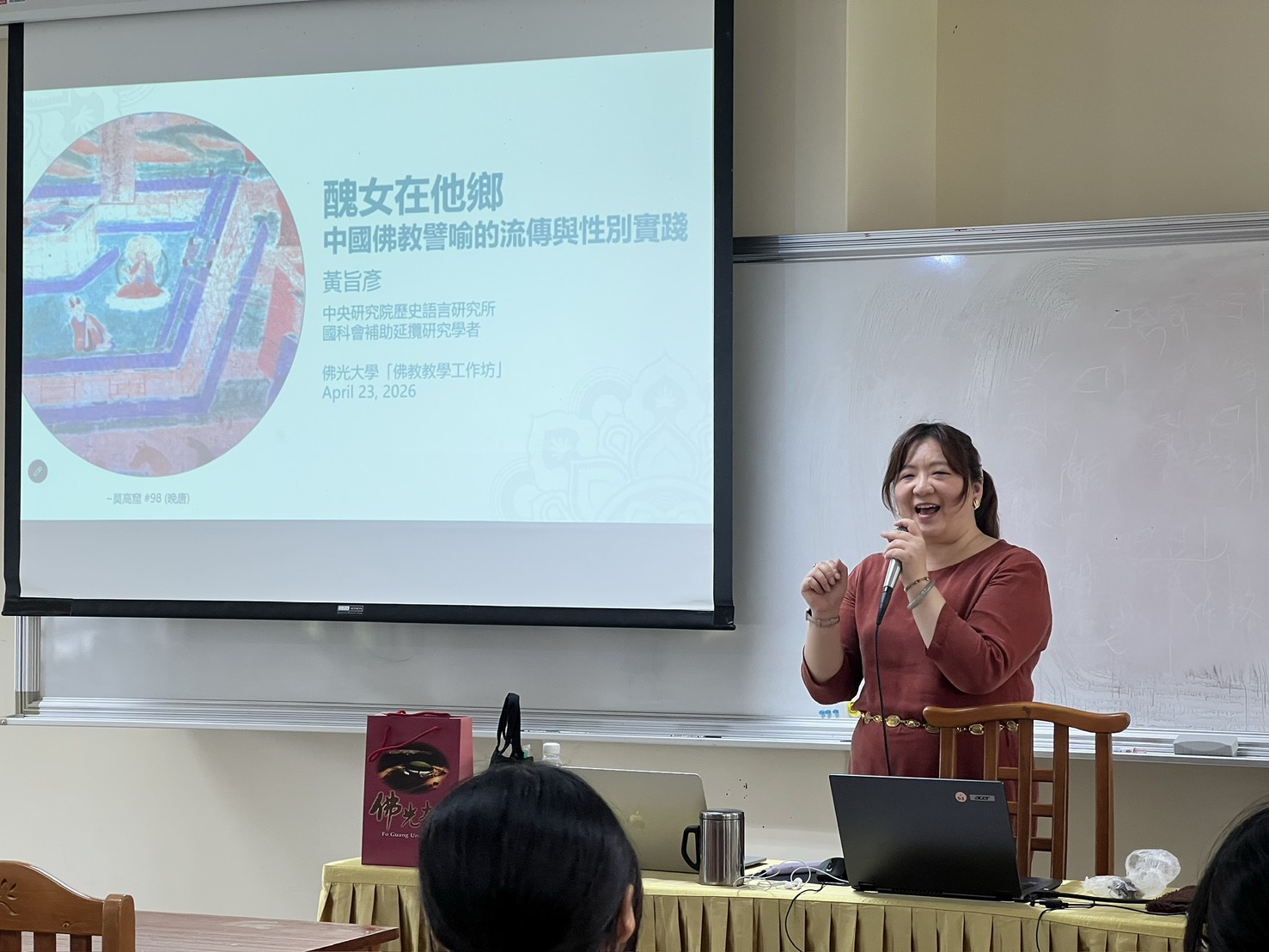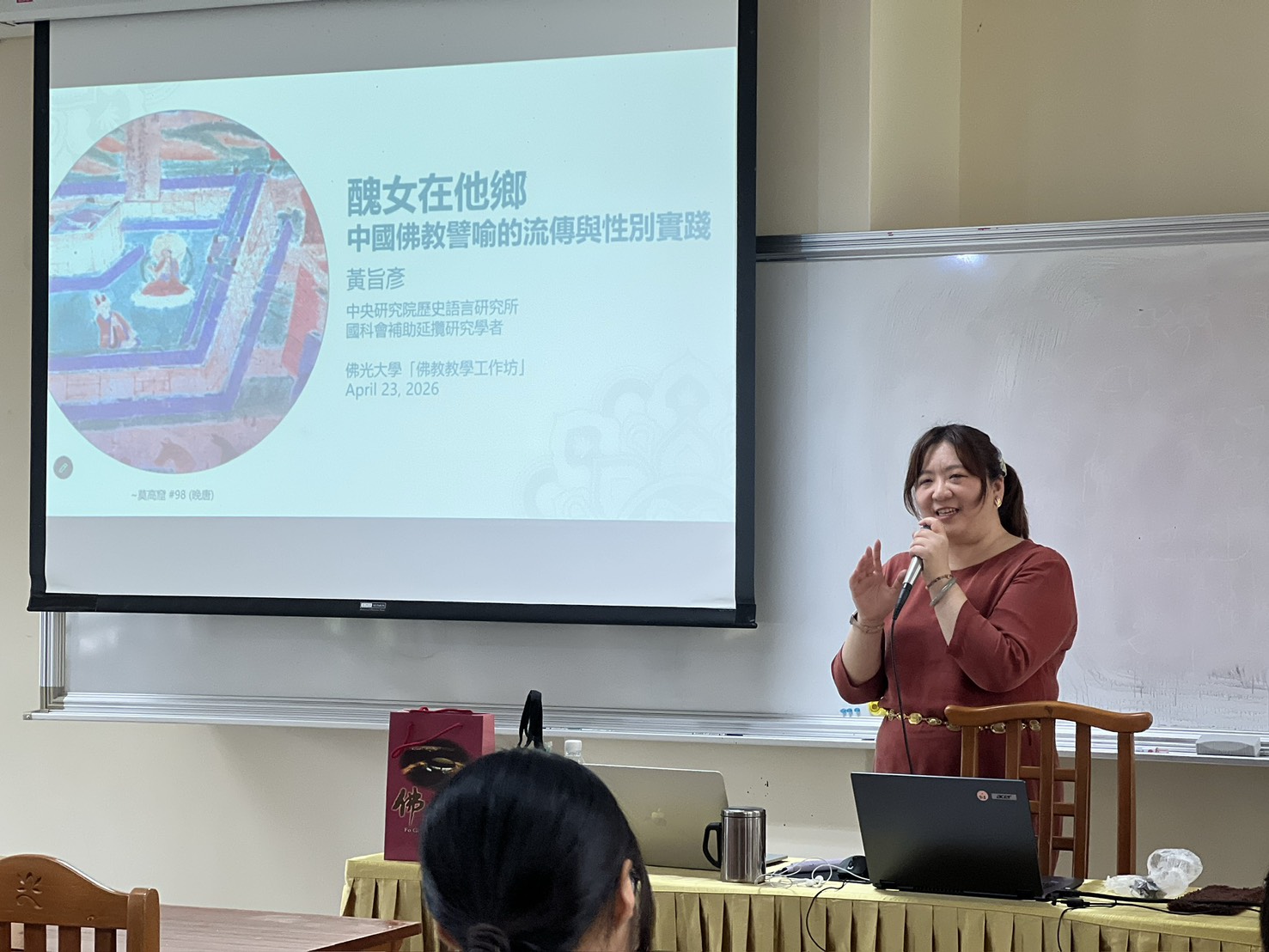

On April 23, 2026, the Center for Buddhist Studies at Fo Guang University hosted a session of its Buddhist Pedagogy Workshop, inviting Huang Zhiyan, a research fellow recruited under the National Science and Technology Council at the Institute of History and Philology, Academia Sinica, to deliver a lecture titled “The Ugly Woman in a Foreign Land: The Transmission of Buddhist Parables in China and the Practice of Gender.” The lecture explored the interaction between textual variation and gender culture through the cross-cultural transmission of Buddhist narrative traditions.
Huang began by introducing the story of the “Ugly Daughter of King Prasenajit,” illustrating how the narrative developed across multiple cultural contexts, including India, Central Asia, and China. She pointed out that extant sources exist in various languages—such as Sanskrit, Chinese, and Tibetan—and that no single “original” or authoritative version survives. This highlights the fluid and plural nature of Buddhist parable traditions.
From a methodological perspective, Huang reflected on earlier scholarship, which has often focused on reconstructing a single lineage of textual transmission or has treated textual variation merely as a byproduct of cultural difference. In contrast, she proposed that textual variation should be regarded as a key analytical tool, enabling scholars to distinguish between different textual systems and to understand how narratives are reinterpreted and reshaped in diverse cultural contexts.
Huang further emphasized that so-called “non-core” narrative elements—particularly changes in social settings—serve as important entry points for examining cultural adaptation. For instance, in Indian and Central Asian contexts, the story often features social gatherings structured around contractual agreements with monetary penalties. In Chinese versions, however, these settings gradually transform into mixed-gender gatherings or communal assemblies (yihui), reflecting local norms governing gender interaction and social conduct.
Huang further emphasized that so-called “non-core” narrative elements—particularly changes in social settings—serve as important entry points for examining cultural adaptation. For instance, in Indian and Central Asian contexts, the story often features social gatherings structured around contractual agreements with monetary penalties. In Chinese versions, however, these settings gradually transform into mixed-gender gatherings or communal assemblies (yihui), reflecting local norms governing gender interaction and social conduct.
In addition, Huang analyzed transformations in the narrative identity of the male protagonist, noting a shift from a participant in social contractual systems to a figure more aligned with Chinese ethical and social frameworks. Such changes reveal how Buddhist narratives were adapted to accommodate local cultural values and gender norms during their transmission.
From the perspective of gender practice, the figure of the “ugly woman” not only embodies themes of karmic causation and transformation, but also reflects culturally specific ways of perceiving and evaluating the female body. The motif of transformation from ugliness to beauty illustrates the intersection between Buddhist doctrinal concerns and evolving aesthetic and gender norms. Through close textual analysis and cross-cultural comparison, this lecture demonstrated the dynamic nature of Buddhist parable traditions in their historical transmission. It not only deepened students’ understanding of Buddhist literature, but also opened new perspectives on the interaction between gender and culture.