
On May 25, 2022, the Expert Lecture Series of the "Buddhism and Psychotherapy" research project at the Center for Buddhist Studies, Fo Guang University, invited Professor Tsai Yi-jia of the Department of Religious Studies at Fu Jen Catholic University to speak on "A Preliminary Exploration of the Dialogue between Humanistic-Oriented Psychology of Religion and Buddhism." The session was moderated by Prof. Guo Chao-Shun, General Director of the research project and Dean of the College of Buddhist Studies. More than ninety attendees, including faculty and students from the Departments of Buddhist Studies, Psychology, and Religious Studies, as well as guests from outside the university, participated online.
Is the Psychology of Religion "Religion" and "Psychology"? Or is it the "Psychology of Religion"? Prof. Tsai began by tracing the historical development in Taiwan and North America, introducing how this discipline gradually moved toward an independent academic position amidst the shifting landscapes of religion, psychology (both humanistic and scientific), culture, politics, and society. She highlighted that it now has major representative figures, research scopes, and diverse methodologies, providing a channel for human unique experiences and religious sacredness to be touched, interpreted, and connected.
Prof. Tsai introduced research approaches in the Psychology of Religion through figures such as William James (the father of American psychology), Sigmund Freud (founder of psychoanalysis), Ana-Maria Rizzuto (Object Relations), and Carl G. Jung (founder of analytical psychology, who profoundly influenced the East). Topics covered included: individual religious experiences that help humans expand deeper understanding, mystical states of consciousness, experiential reality, the object-nature of the sacred, the sacred object as a projection versus support for a mature relationship, the world of illusion/phantasy, symbols as important intermediaries toward the real world, and the recognition and acknowledgment of religion as indispensable to personality development.
Finally, Prof. Tsai cited a paper previously presented by Dean Guo Chao-Shun titled "Difficulties and Possible Solutions in the Dialogue between Buddhism and Psychology" (International Conference on Globalization and Religious Secularism in the Post-Pandemic Era, Dec. 10-11, 2021). She quoted: "A mature self aids the process of practicing non-self, but a self full of splits and afflictions might use 'transcending the self' as a form of [escapist] liberation." She pointed out the psychological crises that the Psychology of Religion also cares about, proposing concepts such as "Reality," "Self," "Transcending Self," and "Language" as points for dialogue with Buddhism.
Dean Guo responded that from a Buddhist standpoint, based on "Dependent Origination and Emptiness of Nature," Buddhism rejects the existence of an ultimate essence, but does not reject existing phenomena. "Emptiness" is what Buddhism considers "Reality." "Language" plays the role of a tool that can point humans toward transcendent liberation, unbound by the social realities constructed by language. However, language simultaneously obscures the truth of Emptiness. This is where humans easily fall into the trap of regarding inner experiences as a "Self," or viewing the recognized sacredness as a transcendent "Self," thereby falling into more solidified attachment and danger. Ultimately, the goal of Buddhism is to help people leave suffering and break through ignorance, moving toward a final, un-obscured liberation and freedom. This marks the primary difference between Buddhism and most religions and psychologies.
Prof. Tsai also noted that the reason psychology later moved toward a "quasi-religious" direction is that they discovered the obscuration caused by scientific objectification and rigid views of reality. Consequently, they proposed more observational and empirical research to enable humans to describe a more transcendent space and sacredness through language, with the goal also being to help humans alleviate suffering.
Dean Guo further shared that the East seems to recognize Carl Jung as a religious leader, leading to a tendency toward a "view of inherent self" (svabhava) within religion or Buddhism. Prof. Tsai responded that Jung had stated he was not a theologian and could not handle such theological issues, thus returning to the level of "experience" that psychology can address. This approach remains where psychological research can make contact and contribute. This dialogue clarified the levels, boundaries of scope, and the functions and standing points of psychological methods.
The differences and similarities between Religion, Psychology, and Buddhist Studies were concretely presented once again in this lecture. Dean Guo stated that since Buddhism views the mundane world as illusory, it cannot fully address all the complex problems of modern society on its own. Therefore, it needs to cooperate with different disciplines to truly implement the Buddhadharma in modern times; this is also the core objective of this research project.
As the final lecture of the "Buddhism and Psychotherapy" project, the content ingeniously returned to a blend of dialogue, cooperation, and mutual adoption of perspectives. It demonstrated that religious teachers, scholars of religion, philosophers, and psychologists who care about human well-being all share a common vision of helping others leave suffering and benefiting sentient beings. The sparks from each lecture can perhaps be likened to successive phenomenological fields of sacred experience; the resonance and exchange of the scholars' life essence serve as the best witness to our joint progress toward the good.
Is the Psychology of Religion "Religion" and "Psychology"? Or is it the "Psychology of Religion"? Prof. Tsai began by tracing the historical development in Taiwan and North America, introducing how this discipline gradually moved toward an independent academic position amidst the shifting landscapes of religion, psychology (both humanistic and scientific), culture, politics, and society. She highlighted that it now has major representative figures, research scopes, and diverse methodologies, providing a channel for human unique experiences and religious sacredness to be touched, interpreted, and connected.
Prof. Tsai introduced research approaches in the Psychology of Religion through figures such as William James (the father of American psychology), Sigmund Freud (founder of psychoanalysis), Ana-Maria Rizzuto (Object Relations), and Carl G. Jung (founder of analytical psychology, who profoundly influenced the East). Topics covered included: individual religious experiences that help humans expand deeper understanding, mystical states of consciousness, experiential reality, the object-nature of the sacred, the sacred object as a projection versus support for a mature relationship, the world of illusion/phantasy, symbols as important intermediaries toward the real world, and the recognition and acknowledgment of religion as indispensable to personality development.
Finally, Prof. Tsai cited a paper previously presented by Dean Guo Chao-Shun titled "Difficulties and Possible Solutions in the Dialogue between Buddhism and Psychology" (International Conference on Globalization and Religious Secularism in the Post-Pandemic Era, Dec. 10-11, 2021). She quoted: "A mature self aids the process of practicing non-self, but a self full of splits and afflictions might use 'transcending the self' as a form of [escapist] liberation." She pointed out the psychological crises that the Psychology of Religion also cares about, proposing concepts such as "Reality," "Self," "Transcending Self," and "Language" as points for dialogue with Buddhism.
Dean Guo responded that from a Buddhist standpoint, based on "Dependent Origination and Emptiness of Nature," Buddhism rejects the existence of an ultimate essence, but does not reject existing phenomena. "Emptiness" is what Buddhism considers "Reality." "Language" plays the role of a tool that can point humans toward transcendent liberation, unbound by the social realities constructed by language. However, language simultaneously obscures the truth of Emptiness. This is where humans easily fall into the trap of regarding inner experiences as a "Self," or viewing the recognized sacredness as a transcendent "Self," thereby falling into more solidified attachment and danger. Ultimately, the goal of Buddhism is to help people leave suffering and break through ignorance, moving toward a final, un-obscured liberation and freedom. This marks the primary difference between Buddhism and most religions and psychologies.
Prof. Tsai also noted that the reason psychology later moved toward a "quasi-religious" direction is that they discovered the obscuration caused by scientific objectification and rigid views of reality. Consequently, they proposed more observational and empirical research to enable humans to describe a more transcendent space and sacredness through language, with the goal also being to help humans alleviate suffering.
Dean Guo further shared that the East seems to recognize Carl Jung as a religious leader, leading to a tendency toward a "view of inherent self" (svabhava) within religion or Buddhism. Prof. Tsai responded that Jung had stated he was not a theologian and could not handle such theological issues, thus returning to the level of "experience" that psychology can address. This approach remains where psychological research can make contact and contribute. This dialogue clarified the levels, boundaries of scope, and the functions and standing points of psychological methods.
The differences and similarities between Religion, Psychology, and Buddhist Studies were concretely presented once again in this lecture. Dean Guo stated that since Buddhism views the mundane world as illusory, it cannot fully address all the complex problems of modern society on its own. Therefore, it needs to cooperate with different disciplines to truly implement the Buddhadharma in modern times; this is also the core objective of this research project.
As the final lecture of the "Buddhism and Psychotherapy" project, the content ingeniously returned to a blend of dialogue, cooperation, and mutual adoption of perspectives. It demonstrated that religious teachers, scholars of religion, philosophers, and psychologists who care about human well-being all share a common vision of helping others leave suffering and benefiting sentient beings. The sparks from each lecture can perhaps be likened to successive phenomenological fields of sacred experience; the resonance and exchange of the scholars' life essence serve as the best witness to our joint progress toward the good.
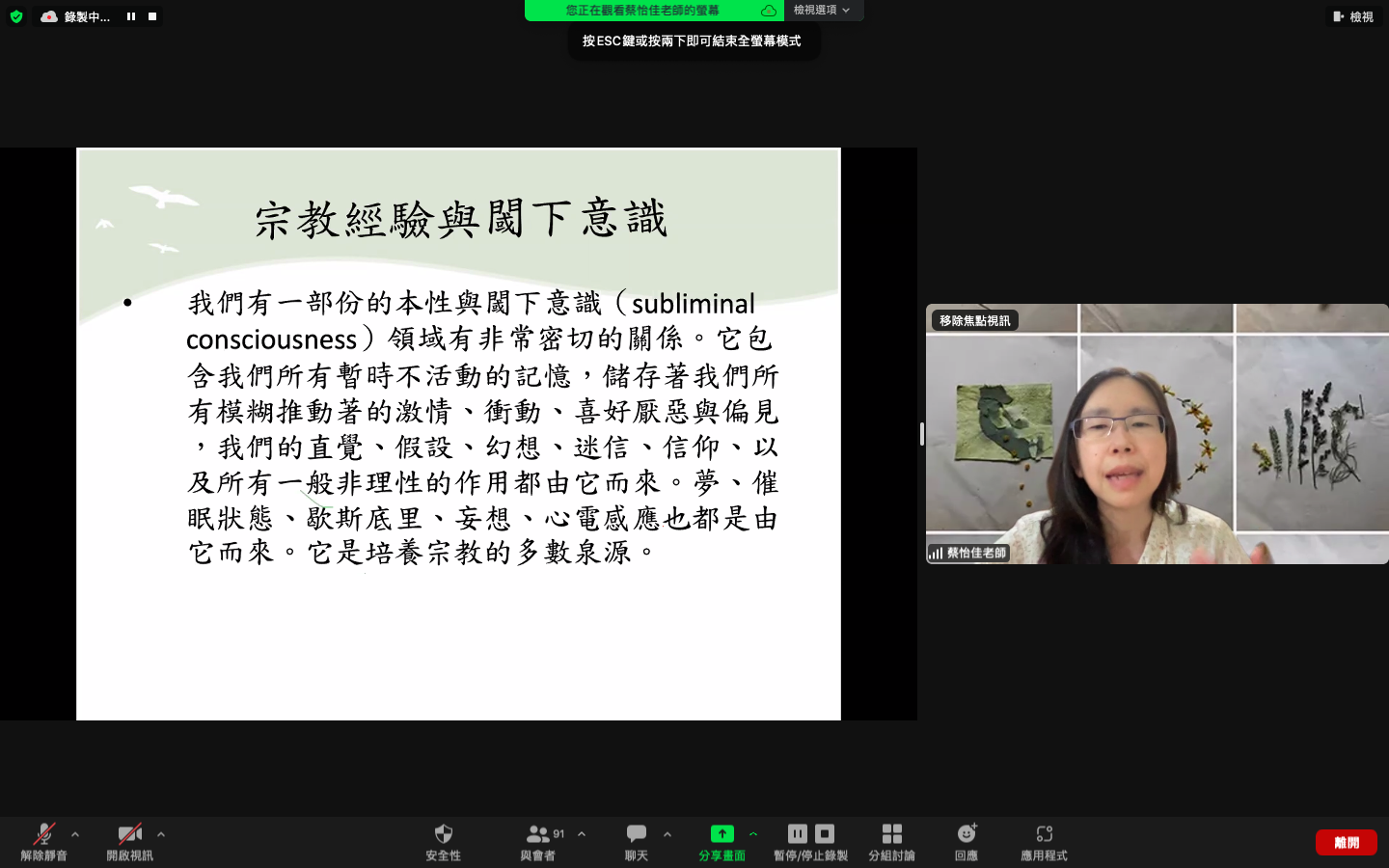
Prof. Tsai Yi-jia delivering the lecture "A Preliminary Exploration of the Dialogue between Humanistic-Oriented Psychology of Religion and Buddhism."

The exchange between Prof. Tsai Yi-jia of the Department of Religious Studies at Fu Jen Catholic University and Dean Guo Chao-Shun, the project's General Director, clarified the scope and boundaries of psychological healing in the two disciplines.