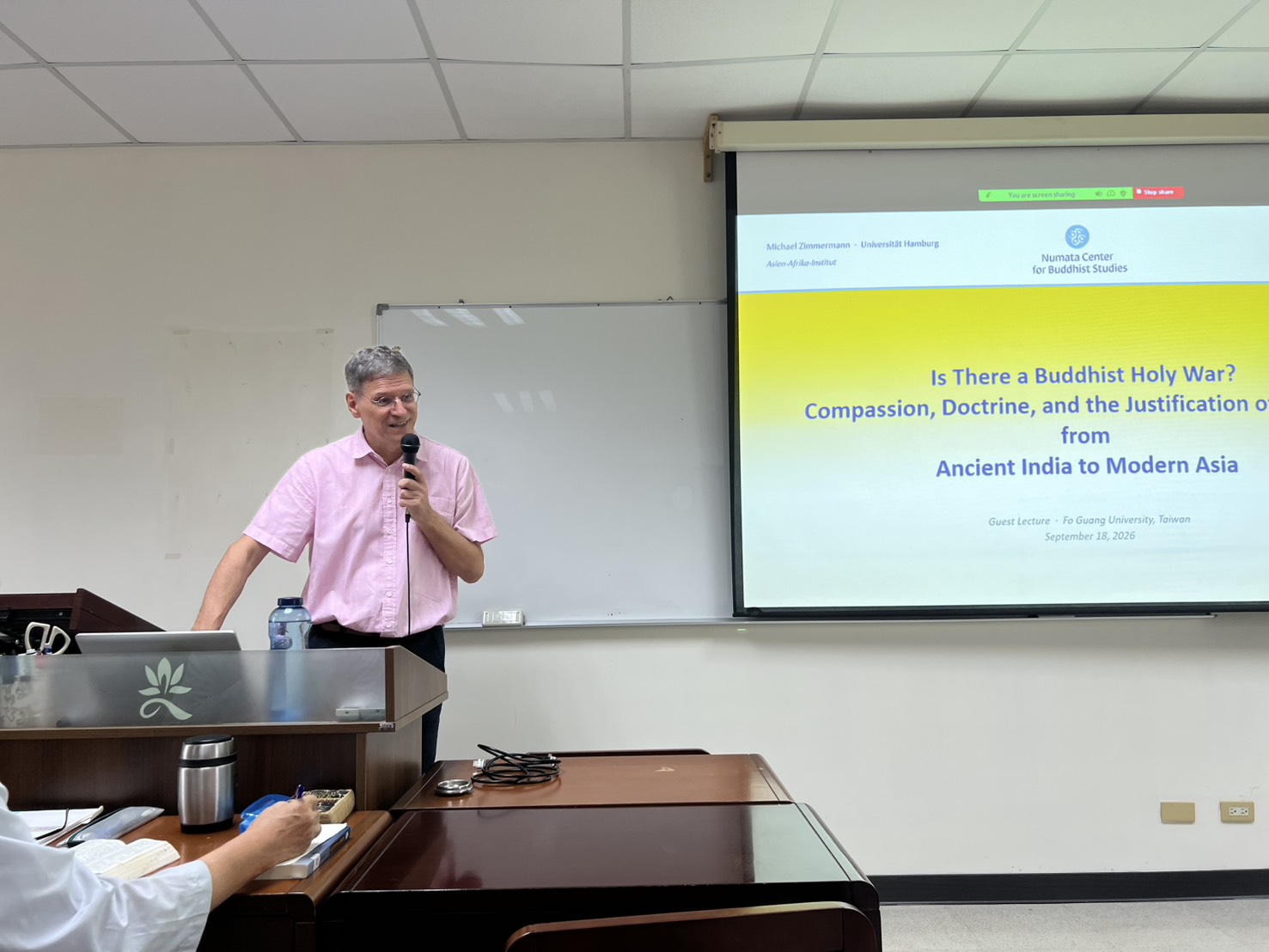

On September 18, 2026, the Center for Buddhist Studies at Fo Guang University hosted a session of its International Distinguished Scholars Lecture Series, inviting Professor Michael Zimmermann of the Asia-Africa Institute and the Numata Center for Buddhist Studies at the University of Hamburg, Germany, to deliver a lecture titled “Is There a Buddhist Holy War? Compassion, Doctrine, and the Justification of Violence from Ancient India to Modern Asia.” Centering on the question of whether Buddhism ever developed an idea comparable to “holy war,” the lecture examined the complex relationship between compassion, doctrine, and the justification of violence, ranging from ancient Indian Buddhist scriptures, Buddhist kingship, Mahāyāna and Tantric texts, to modern Asian Buddhist nationalism and cases of religious violence.
Professor Zimmermann began by taking the Christian traditions of “just war” and “holy war” as a point of comparison, explaining that Christian thought developed a theological discourse capable of linking war with divine command. By contrast, although Buddhism has long interacted with political power—for instance, Buddhist kingship ideology influenced law and governance in parts of Asia—the central concern of this lecture was not whether Buddhism engaged with politics, but whether it ever produced a doctrine capable of systematically justifying war, or even sanctifying it.
Professor Zimmermann then returned to basic Buddhist ethics, pointing out that the first Buddhist precept emphasizes abstaining from killing living beings, in principle even in defensive war. Early canonical sources also contain severe judgments on warfare and killing; for example, a warrior who dies in battle with his mind fixed on killing the enemy is said to incur an unfortunate rebirth. However, when the Buddha interacted with kings who were frequently involved in warfare, he did not directly apply the principle of non-killing to royal governance or matters of state warfare. Instead, the sources reveal a kind of “remarkable reserve,” in which ethics and statecraft are kept apart. This suggests that Buddhism’s encounter with political realities cannot always be reduced to the application of a single ethical principle.
The lecture also addressed pacifist narratives within the Buddhist tradition. Certain Jātaka stories, for example, depict princes or kings who would rather renounce the throne or endure humiliation than maintain power through violence. Yet Professor Zimmermann noted that, while such narratives are important, they do not represent the only voice within the Buddhist tradition. In historical practice, Buddhists could uphold the religious ideal of non-violence while also participating in military action within particular social roles, resulting in what may be described as a compartmentalization of values.
At the scriptural level, Professor Zimmermann paid particular attention to the view of kingship and warfare presented in the Bodhisattva-gocaropāya-viṣaya-vikurvāṇa-nirdeśa, also known in Chinese as the Da Sazhe Niqianzi suoshuo jing 大薩遮尼乾子所說經. Preserved in Chinese and Tibetan translations, the text’s chapter on kingship attempts to explain how a righteous king should act when confronted with war. It first requires the king to make every effort to avoid battle, seeking to resolve conflict through kindness, gifts, favors, or the display of superior strength. If war cannot be avoided, the king must settle his mind on protecting his subjects, resolving to win, and taking enemy soldiers alive rather than killing them. Professor Zimmermann suggested that this may be one of the most systematic Buddhist attempts to formulate something close to a “just war theory,” with its emphasis on restraint, minimized killing, and protection rather than conquest or expansion.
Nevertheless, Professor Zimmermann emphasized that the Da Sazhe Niqianzi suoshuo jing does not truly constitute a theory of “holy war.” The text does not provide a full discussion of just cause or legitimate authority, nor does it connect the death of soldiers with sacred salvation. It also does not suggest that fighting itself is sacred. Thus, although it offers a rare Buddhist discussion of wartime ethics, it should not be equated with the idea of holy war as developed in the Christian tradition.
The lecture further examined several controversial exceptions in Buddhist literature. For instance, certain passages in the Mahāyāna Mahāparinirvāṇa Sūtra concerning icchantikas and the defense of the Dharma speak of lay Buddhists and even kings taking up swords and lances to protect the true teaching. The Kālacakratantra, meanwhile, presents an eschatological war between the king of Shambhala and hostile non-Buddhist forces, and may be regarded as one of the Buddhist narratives that comes closest to the idea of holy war. However, Professor Zimmermann pointed out that the war narrative in the Kālacakratantra was often reinterpreted in later traditions as an inner spiritual struggle, rather than as a direct call to literal armed conflict.
Professor Zimmermann also analyzed the well-known case in the Bodhisattvabhūmi in which a bodhisattva kills a robber. In the story, the bodhisattva kills the robber in order to prevent him from murdering the passengers on a ship and to save him from committing an act with far more severe karmic consequences. This case is often discussed in relation to whether killing motivated by compassion can be justified. Yet Professor Zimmermann cautioned that such an exception belongs to an individual situation and is strictly conditioned by compassionate motivation; it does not amount to a general theory of collective warfare.
In relation to modern and contemporary cases, the lecture discussed Buddhist nationalism in Sri Lanka and Myanmar. Professor Zimmermann noted that Sinhala Buddhist nationalism in Sri Lanka revived the war narrative of King Duṭṭhagāmaṇī from the Mahāvaṃsa, transforming dharma-yuddhaya—originally understood as an inward spiritual struggle—into a concept applied to actual politics and warfare. In Myanmar, the 969 Movement mobilized the numerical symbolism of the Buddha, Dharma, and Sangha as a marker of identity, using sermons, media circulation, economic boycotts, and rumors to construct a narrative in which the Buddhist community was portrayed as under threat. These cases show that Buddhist violence does not necessarily require a fully developed theological system; it may instead emerge through the provisional combination of myth, ethnic identity, sacred geography, and modern nationalism.
Professor Zimmermann concluded that, while the Buddhist tradition does contain a small number of narratives and doctrinal fragments that can be used to justify violence, Buddhism as a whole did not develop a systematic, expansionist theory of “holy war” comparable to the Crusades in Christianity or the jihād tradition in Islam, aimed at conversion or conquest. Even in its most extreme examples, Buddhist-sanctioned violence tends, with few exceptions, to be defensive, protective, or framed as the defense of the Dharma, rather than as active expansion or conquest.
Through cross-religious comparison, scriptural interpretation, and the analysis of modern case studies, this lecture guided participants in reconsidering the tension between Buddhist ethics of compassion and political violence. It challenged simplified assumptions that Buddhism is necessarily peaceful or that religion inevitably leads to violence, while also reminding researchers of the need to distinguish carefully among scriptural doctrine, historical practice, and modern political mobilization. Through Professor Zimmermann’s analysis, faculty and students gained a deeper and more nuanced understanding of Buddhist ethics, religious violence, and the political-religious history of Asia.