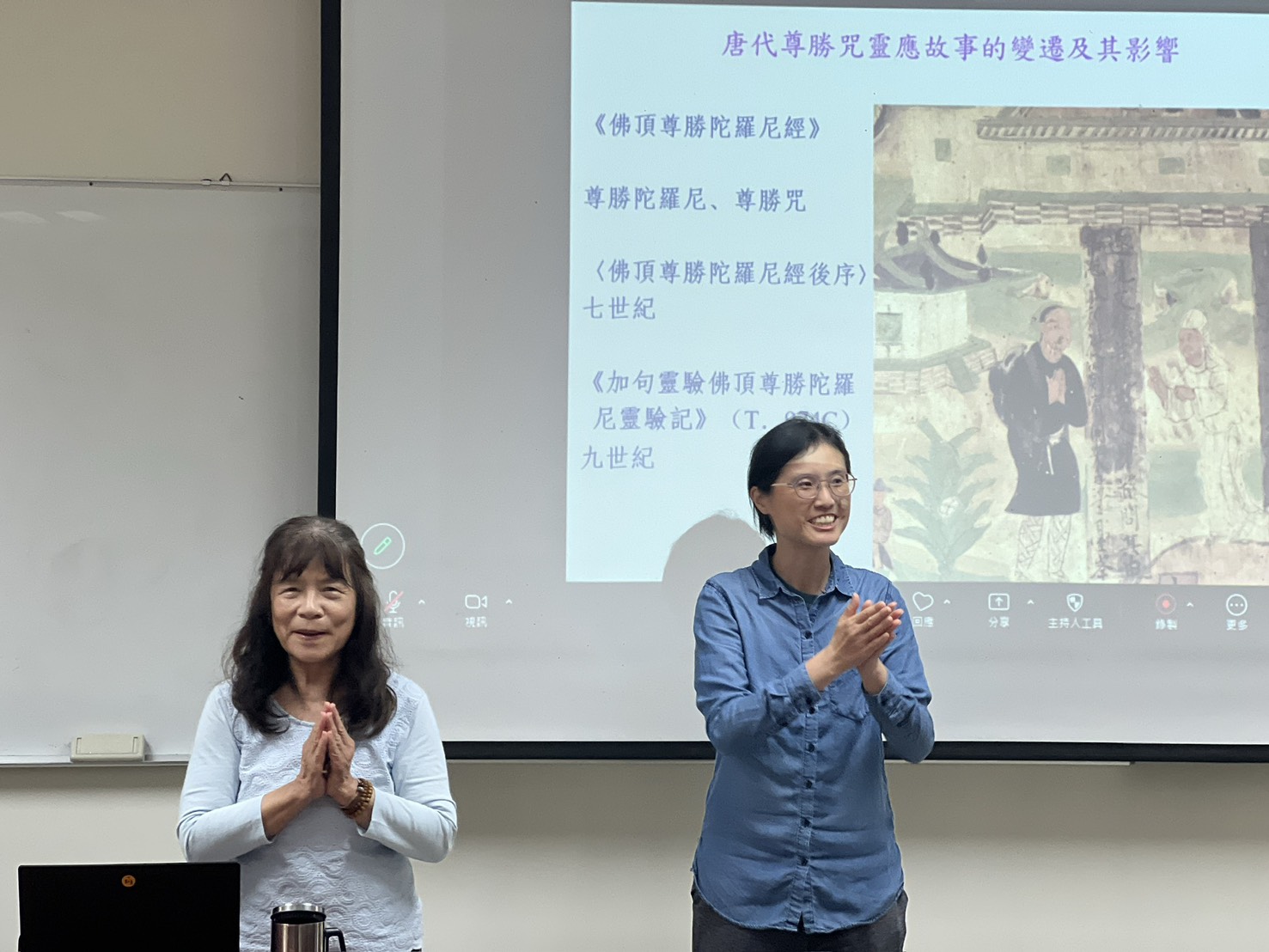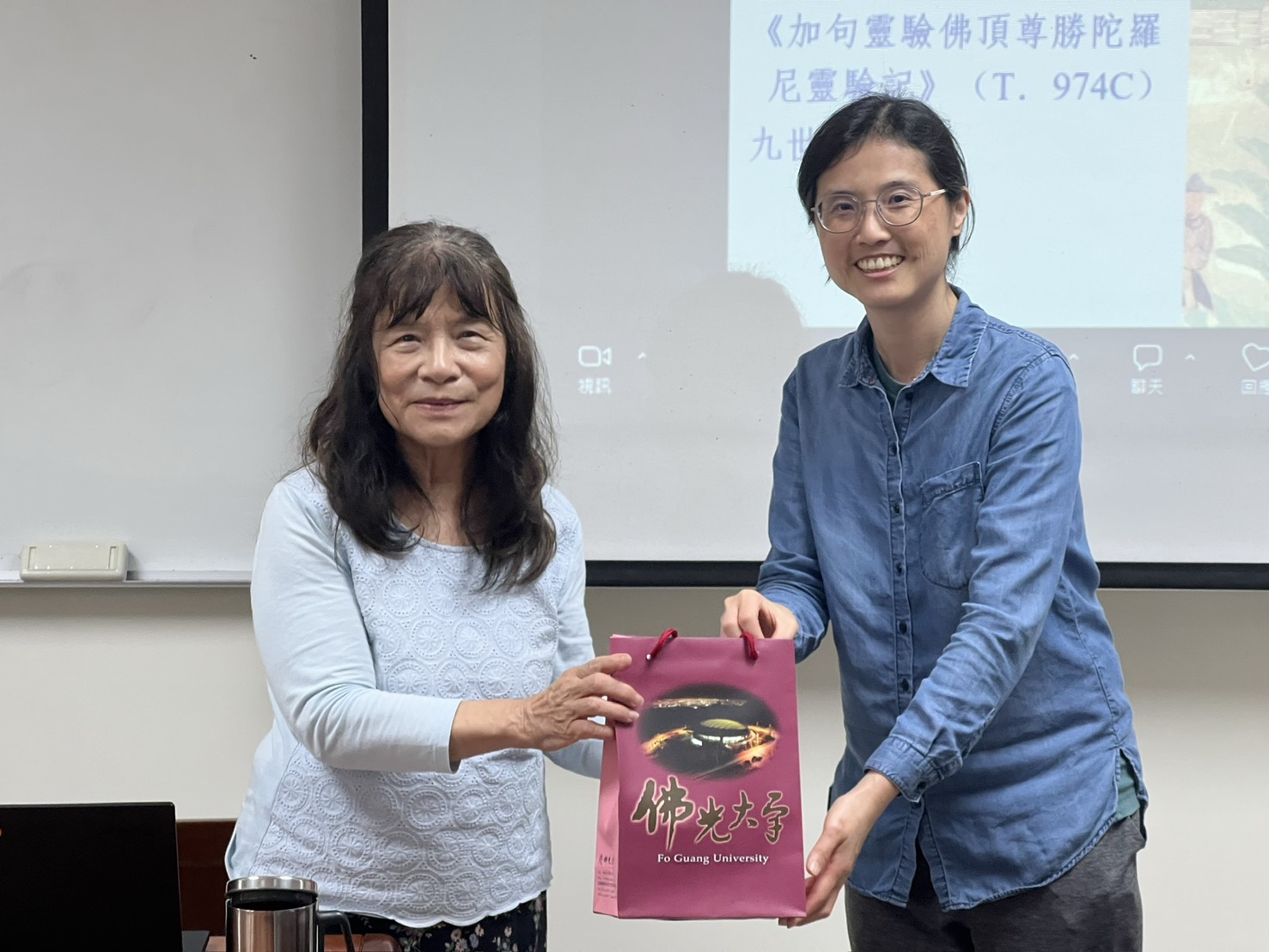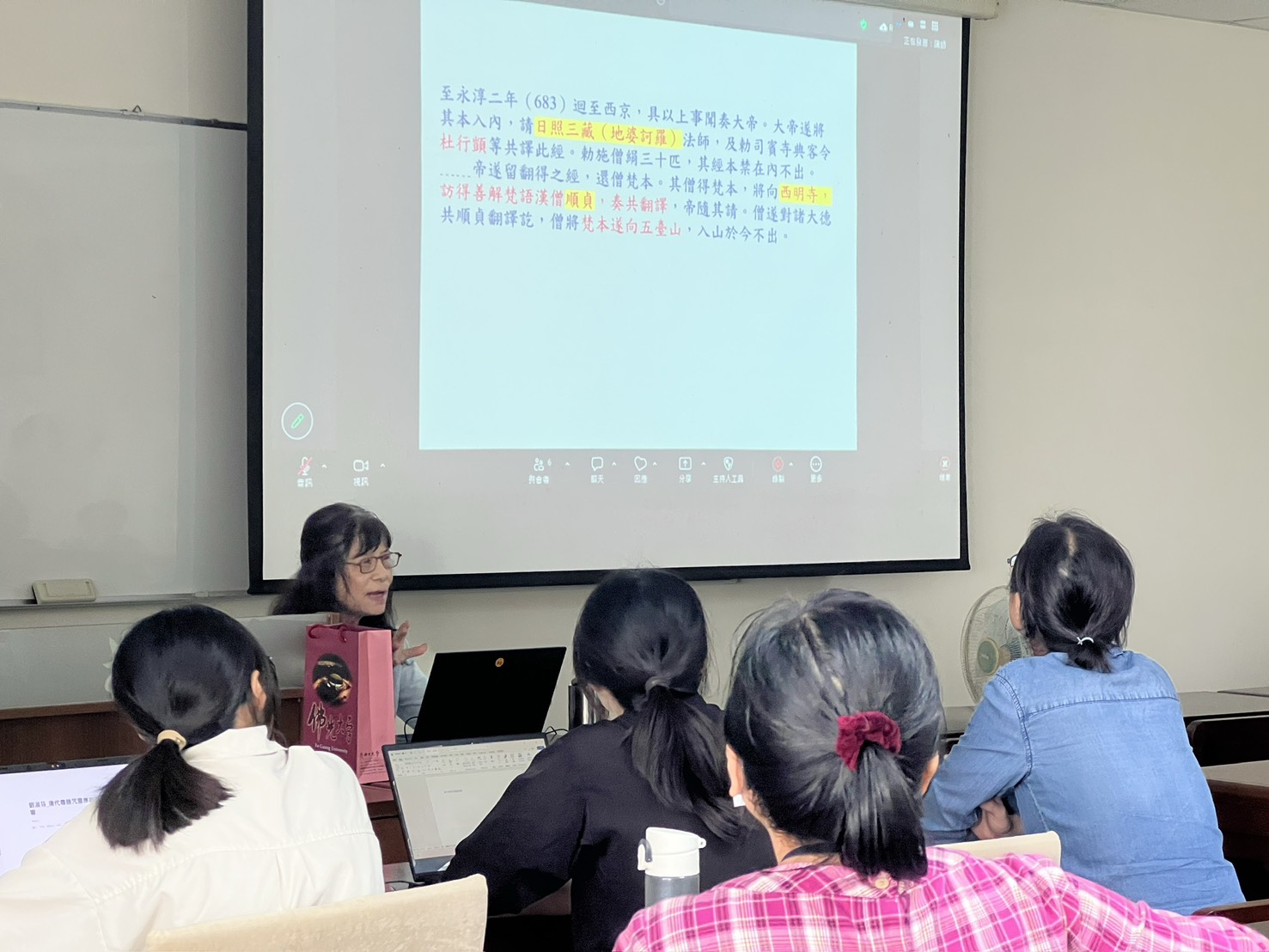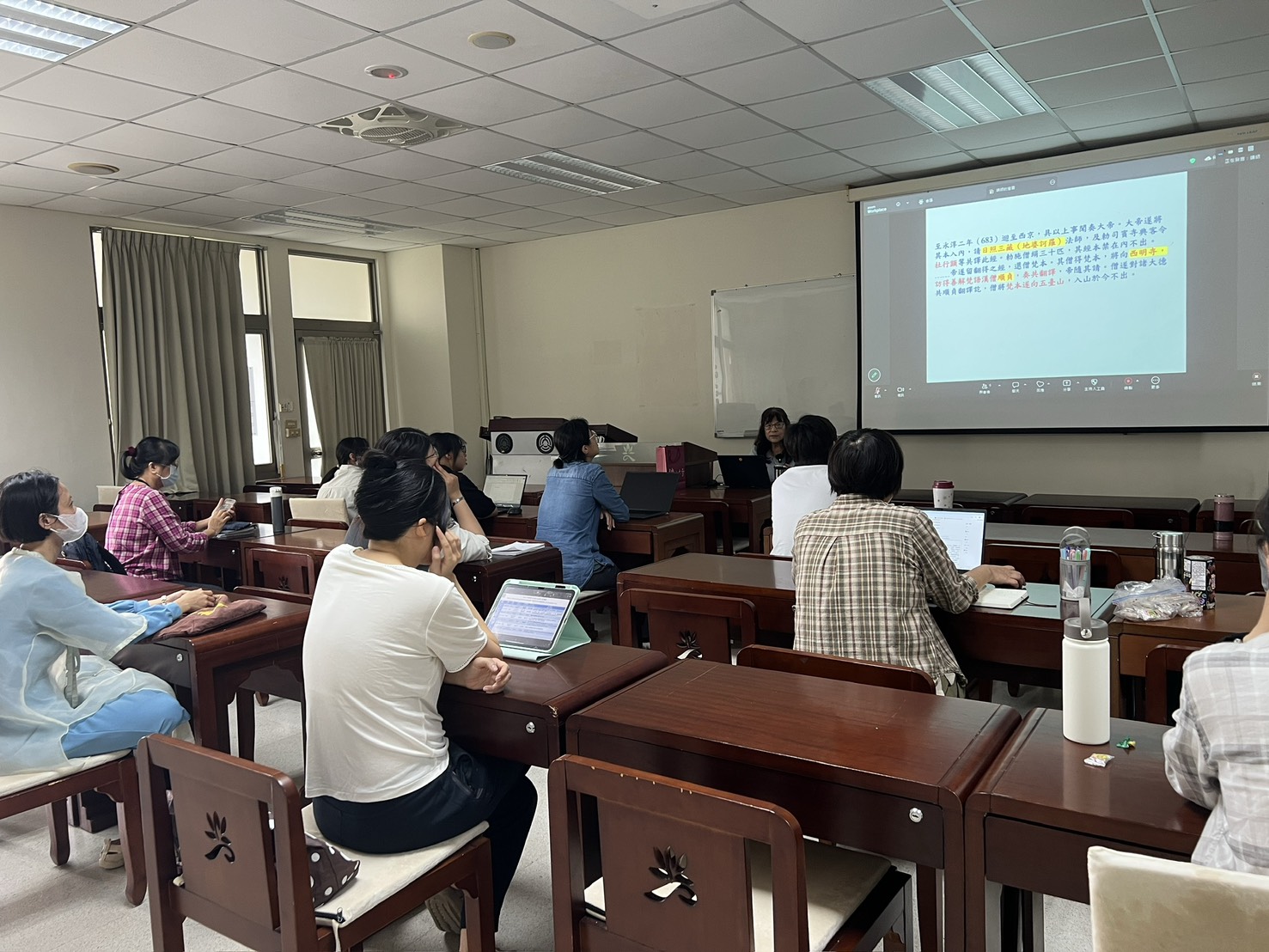

The Center for Buddhist Studies at Fo Guang University hosted a session of its Buddhist Pedagogy Workshop Series on April 29, 2026, inviting Professor Shu-fen Liu of the Institute of History and Philology, Academia Sinica, to deliver a lecture titled “The Transformation and Impact of Miraculous Narratives of the Uṣṇīṣa Vijaya Dhāraṇī in the Tang Dynasty.” Drawing on the Uṣṇīṣa Vijaya Dhāraṇī Sūtra and related miracle accounts, the lecture explored the development, transmission, and social influence of Uṣṇīṣa Vijaya Dhāraṇī devotion from the Tang dynasty onward.
Professor Liu began by tracing the transmission and dissemination of the Uṣṇīṣa Vijaya Dhāraṇī Sūtra, noting that it was introduced into China in the seventh century and rapidly spread during the Tang dynasty. The scripture emphasizes that reciting the dhāraṇī can eliminate karmic obstacles, prolong life, and free beings from the sufferings of hell, making it an important religious practice at the time. She then examined sources such as the Postface to the Uṣṇīṣa Vijaya Dhāraṇī Sūtra and the Record of Augmented Miracles of the Uṣṇīṣa Vijaya Dhāraṇī, showing how miraculous narratives gradually accumulated, evolving from individual experiences into widely circulated religious traditions. Examples such as Zhang Chengfu’s protection from bandits through recitation, his return from death, and accounts of the deceased ascending to heaven or escaping hell through the power of the dhāraṇī helped students understand the formation and transformation of these miracle narratives.
From the perspective of material culture, Professor Liu also provided a detailed account of the emergence and development of dhāraṇī pillars (jingchuang). These stone monuments, which first appeared in the Tang dynasty, are typically inscribed with the Uṣṇīṣa Vijaya Dhāraṇī Sūtra and are commonly found in temples, along major roads, and near tombs. Their function extended beyond the dissemination of scripture: through the concepts of “shadow-contact” and “dust-contact,” even incidental interaction—such as being touched by the pillar’s shadow or dust—was believed to eliminate sins and generate merit.
Professor Liu further pointed out the close connection between Uṣṇīṣa Vijaya Dhāraṇī devotion and the widespread belief in hell and karmic retribution. From the Tang dynasty onward, ideas of judgment in the underworld and karmic consequences became deeply embedded in society. Miracle narratives frequently feature motifs such as resurrection and underworld judgment, reinforcing faith in the efficacy of dhāraṇī recitation and merit-making practices. These beliefs were also closely intertwined with filial piety, as families commissioned dhāraṇī pillars or recited the dhāraṇī to ensure the salvation of deceased relatives.
Finally, Professor Liu addressed the transmission of different versions of the dhāraṇī, including translations by Buddhapāli, Divākara, Yijing, Śubhakarasiṃha, and Amoghavajra, among others, totaling seven known versions. These variations reflect the dynamic processes of expansion and transformation that Buddhist texts underwent during their transmission.
Through the combined perspectives of scripture, miracle narratives, and material culture, Professor Shu-fen Liu demonstrated the multiple functions and far-reaching impact of Uṣṇīṣa Vijaya Dhāraṇī devotion in Tang society. The lecture was rich in content and provided participants with valuable insights, leaving students with a deeper understanding of medieval Chinese Buddhism.