
On June 10, 2026, the Center for Buddhist Studies at Fo Guang University held a lecture in its Buddhist art lecture series, “Images, Sound, and Textual Dissemination of Buddhism.” The Center invited Ms. Ren Jing, Lecturer at the School of Archaeology and Museology at Shanxi University, to deliver a special lecture titled “The Mahāparinirvāṇa Sūtra and Parinirvāṇa Transformation Tableaux.” Conducted online, the lecture transcended geographical limitations and enabled faculty members and students to engage in discussion on the interaction between Buddhist scriptures and cave-temple art. A total of twenty faculty members and participants attended the event.
Ms. Ren began by outlining the development of Buddhist thought on nirvāṇa, noting that the Buddha’s passing into parinirvāṇa was not only a significant event in Buddhist history, but also one of the most representative themes in Buddhist art. Taking the Parinirvāṇa relief in Cave 11 of the Northern Wei Yungang Grottoes as her central case study, she combined archaeological materials, iconographic research, and Buddhist textual sources to explore the formation of early Chinese Parinirvāṇa imagery and its scriptural basis.
During the lecture, Ms. Ren offered a detailed analysis of the composition of the Parinirvāṇa image in Yungang Cave 11. She examined such elements as the reclining Śākyamuni Buddha, secular mourners with disheveled hair, offering monks, and lions, and compared them with Parinirvāṇa images from Gandhāra, Kizil in Xinjiang, Bamiyan, and Dunhuang. She pointed out that the Parinirvāṇa imagery at Yungang inherited artistic traditions from India and Central Asia while also incorporating local cultural and aesthetic features of the Northern Wei period, demonstrating the localization of Buddhist imagery during its transmission.
Ms. Ren also paid particular attention to the relationship between image and text. Drawing on the Buddhacarita, the Abhiniṣkramaṇa sūtra, and several Chinese translations of the Mahāparinirvāṇa Sūtra, she analyzed the possible textual sources for the mourners with loosened hair depicted in the images. She suggested that these visual elements may be related to scriptural descriptions of mourning practices, while also reflecting contemporary cultural understandings of death and grief. She further discussed how Parinirvāṇa imagery gradually developed independently from the narrative cycle of the Buddha’s life and later exerted far-reaching influence on Parinirvāṇa art at sites such as the Longmen Grottoes, Gongxian Grottoes, and the Mogao Caves at Dunhuang.
Through rich visual materials and careful textual analysis, Ms. Ren demonstrated the close relationship among Buddhist scriptures, religious practice, and artistic creation. The lecture enabled participants to reconsider the transmission and visualization of the Mahāparinirvāṇa Sūtra from an interdisciplinary perspective. Combining scholarly depth with visual appreciation, the lecture received an enthusiastic response from participating faculty members and students.
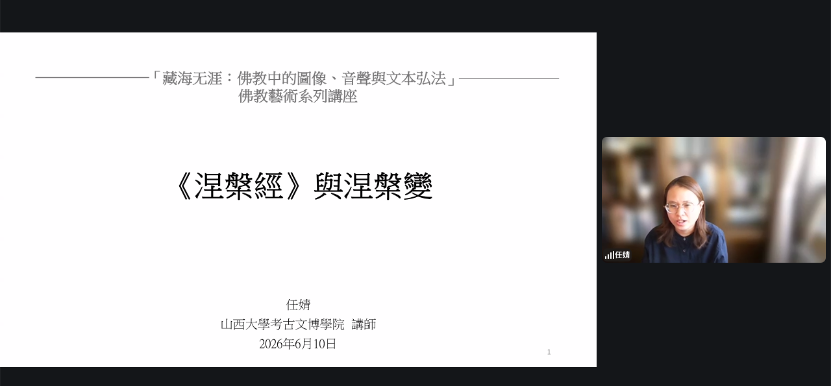
Ms. Ren Jing delivers a lecture titled “The Mahāparinirvāṇa Sūtra and Parinirvāṇa Transformation Tableaux.”
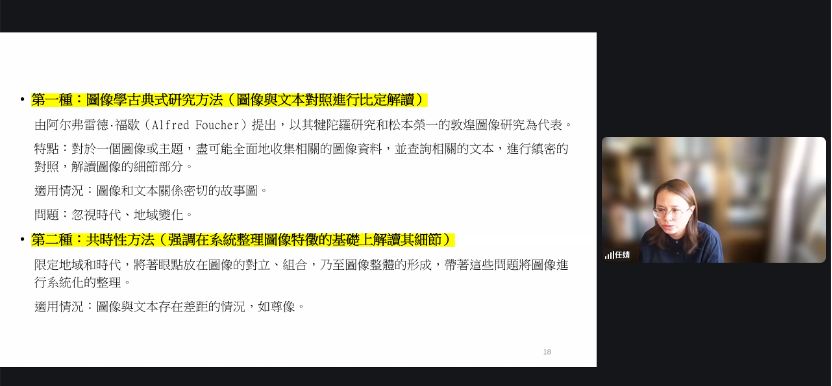
Ms. Ren Jing introduces classical imagery and synchronic research methods.
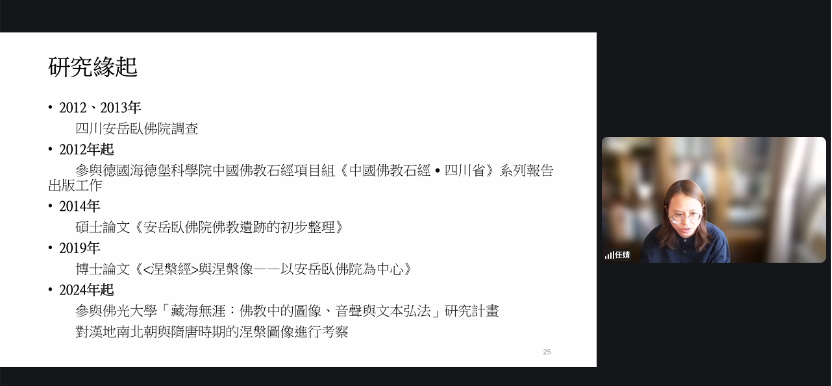
Ms. Ren Jing explains the origins and motivation of her research.
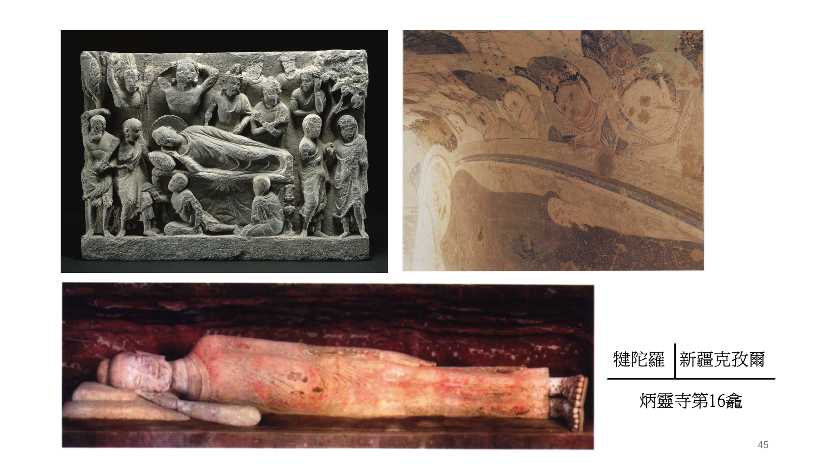
Ms. Ren Jing uses cave-temple examples to introduce Parinirvāṇa imagery.

Students actively participate in the Q&A session.