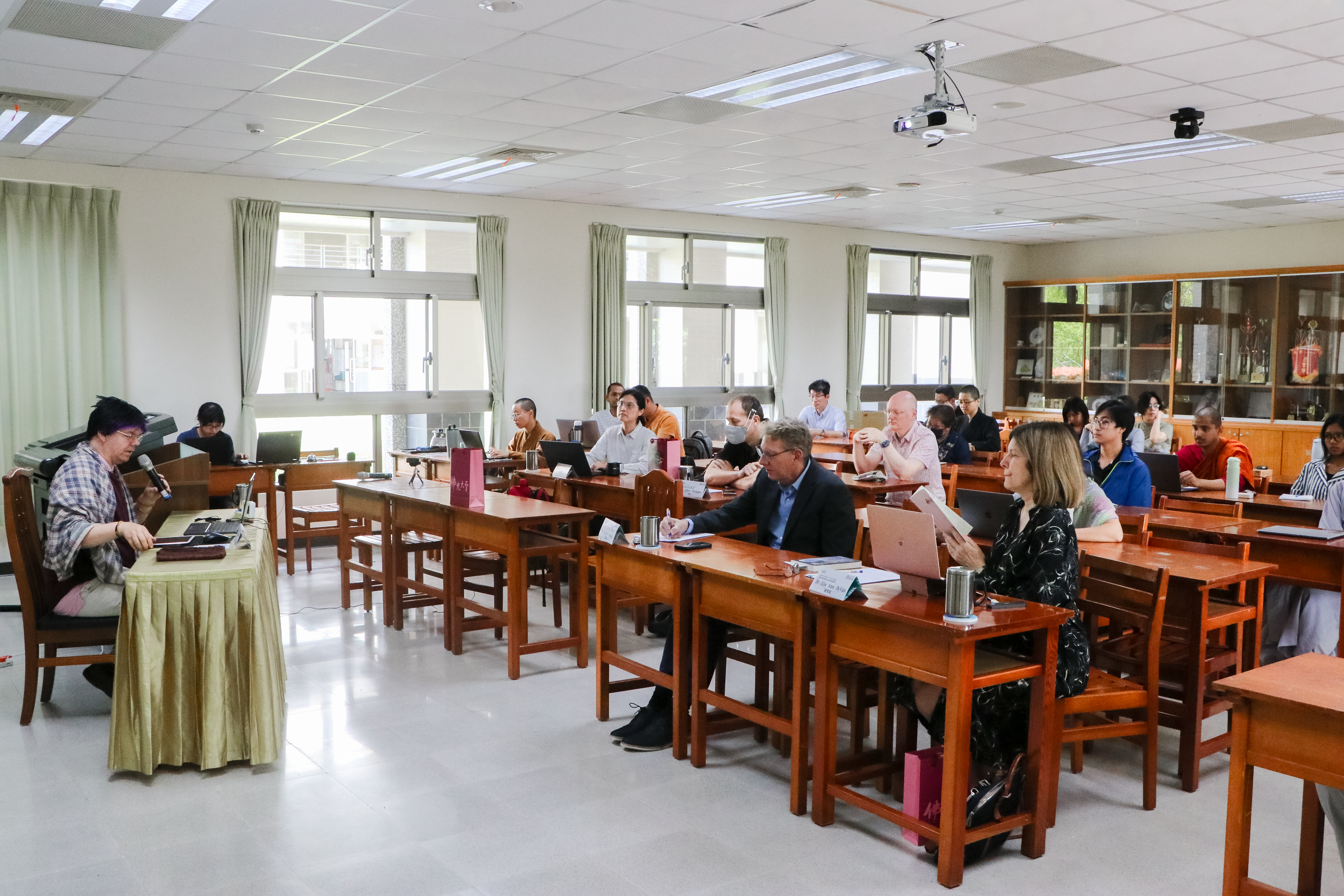
On April 18, 2025, the Center for Buddhist Studies at Fo Guang University hosted the "Workshop on Ethical Living in a Complex World: A Buddhist Perspective." The event featured four distinguished scholars—Dr. Bee Scherer, Dr. Randall Nadeau, Dr. Elise A. Devido, and Dr. Jeffery Nicolaisen—who explored the intersections of Buddhist ethics with gender, animal rights, and modern practice.
Dr. Bee Scherer (Vrije Universiteit Amsterdam) opened the session by bridging Buddhist philosophy with Queer theory. Reinterpreting traditional Jātaka tales alongside contemporary art, Scherer proposed the concept of "Queer Dharmology." This framework seeks to rethink Buddhist concepts to reflect modern social realities, offering a path of liberation for marginalized and oppressed groups by navigating the tensions between desire, subjectivity, and belonging.
Dr. Randall Nadeau (Fulbright Taiwan) analyzed the evolution of Dharma practice through the lens of Master Hsing Yun’s teachings. He identified three critical "turns": the ontological turn (from dualism to non-self), the soteriological turn (from individual liberation to Bodhisattva compassion), and the practical turn toward Humanistic Buddhism. He emphasized that in this tradition, monastics and laity walk a unified path, striving for transcendence within daily life.
Dr. Elise A. Devido (Tzu Chi University) examined gender consciousness in Republican-era China. Drawing on the Sequel to the Biographies of Nuns, she explored how Western thought influenced debates on female ordination and the "Buddhistized Family." She argued that these discussions were not merely ethical but were deeply intertwined with nation-building and social justice efforts during a volatile historical period.
Dr. Jeffery Nicolaisen (Hsuan Chuang University) presented a comparative study on animal ethics between Venerable Shih Chao-hwei and bioethicist Peter Singer. He contrasted Chao-hwei’s approach—grounded in Dependent Origination and the infinite compassion of the Bodhisattva—with Singer’s "Effective Altruism," which relies on rational calculation. The discussion highlighted the distinct motivations behind religious compassion versus secular rationalism.
The workshop concluded with a panel discussion featuring FGU professors, fostering a lively dialogue on how Buddhist ethics can address the complexities of the modern world.