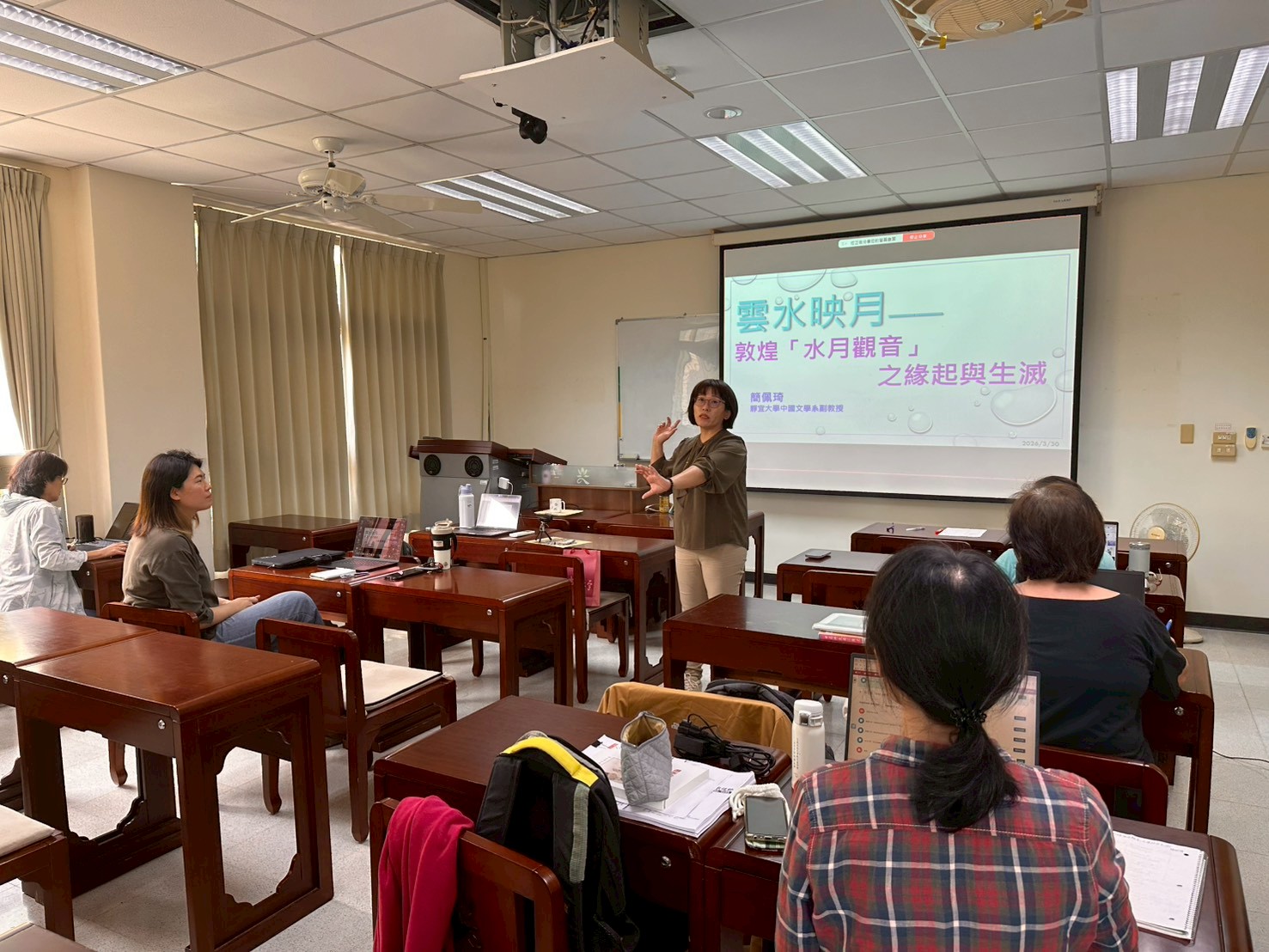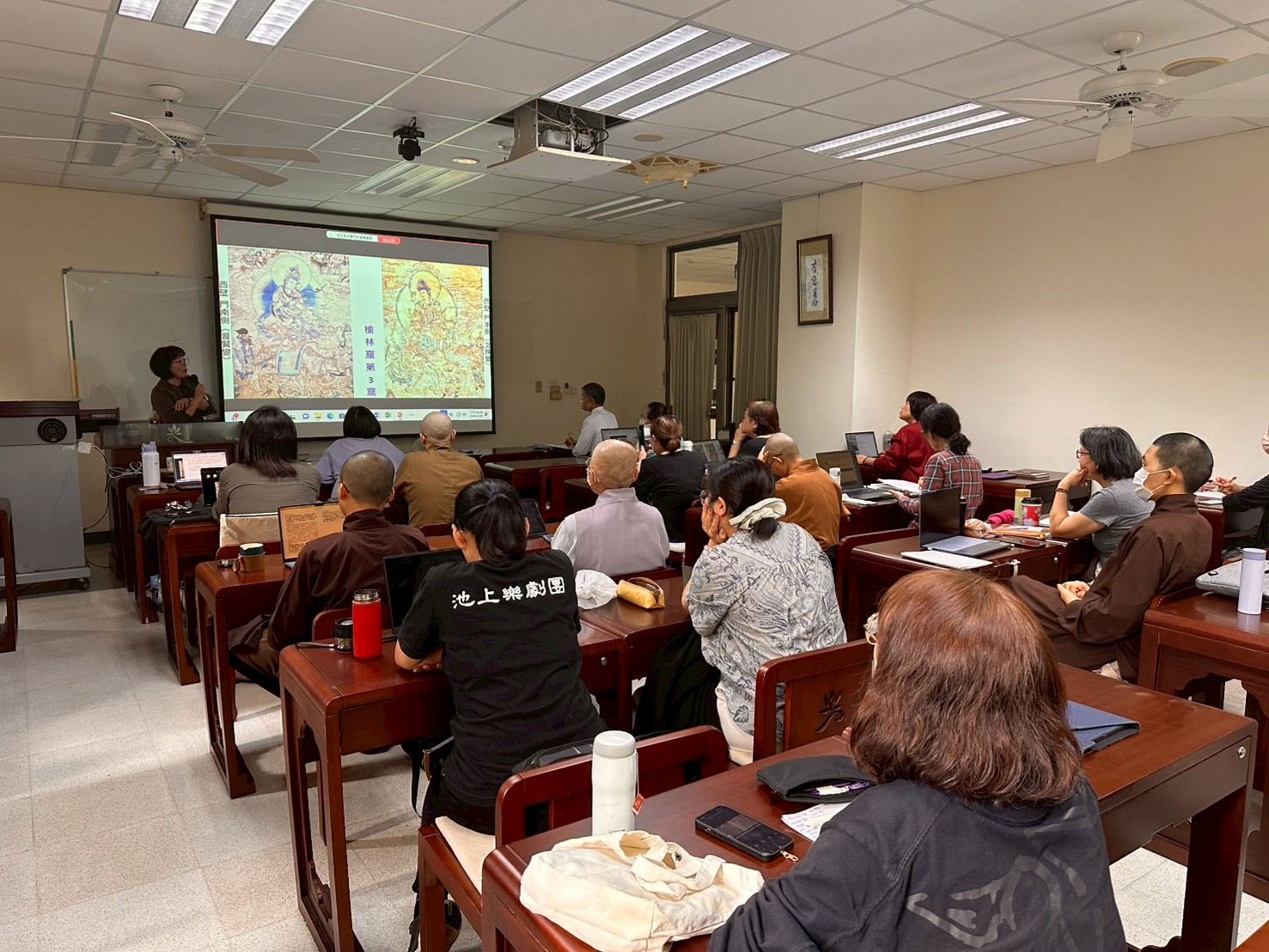

On March 30,2026, the Center for Buddhist Studies at Fo Guang University launched the first lecture of its Buddhist Art Series, titled “Images, Sounds, and Texts in the Propagation of Buddhism.” The event was held in Room N202 on campus. The lecture, titled “Reflections of the Moon on Water: The Origin and Transformation of the ‘Water-Moon Avalokiteśvara’ in Dunhuang,” featured Associate Professor Jian Peiqi from the Department of Chinese Literature at Providence University, and attracted a large audience of students and faculty members.
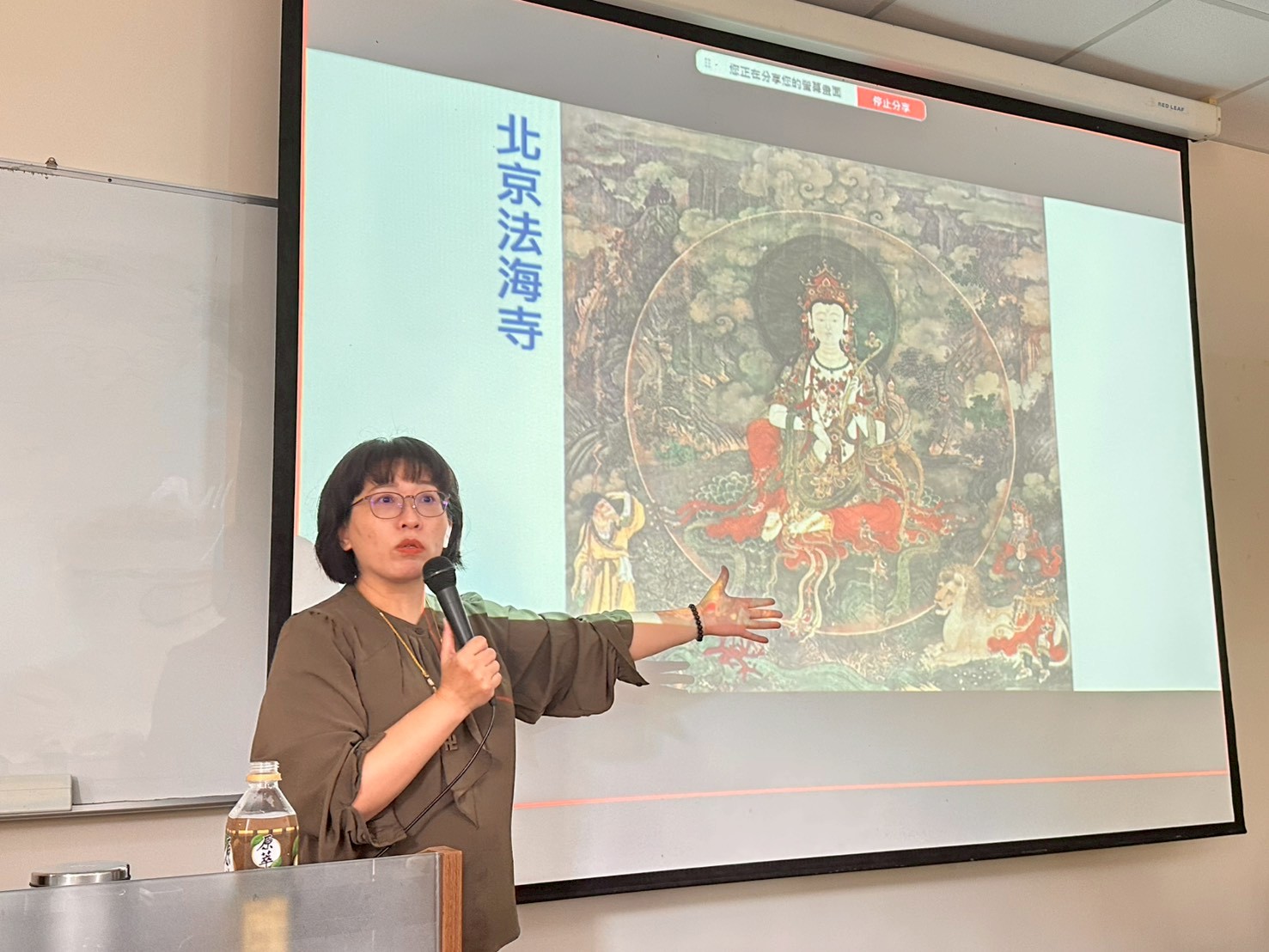
Professor Jian noted that her academic background combines art historical analysis with textual studies, emphasizing the importance of interpreting images in conjunction with written sources. At the beginning of the lecture, she used bodhisattva paintings from Fahai Temple in Beijing as examples to guide students in identifying different bodhisattva iconographies, highlighting that understanding the formation and classification of images is fundamental to art historical research.
Turning to textual sources, she explained that the Tang dynasty painter Zhou Fang has traditionally been credited with “creating the form of the Water-Moon [Avalokiteśvara],” thus regarded as the origin of this iconographic type. However, she cautioned that such art historical records are often temporally distant from the figures they describe, and therefore require careful evaluation regarding their reliability.
In terms of material evidence, Professor Jian examined early representations of the Water-Moon Avalokiteśvara through examples such as the mural in Cave 7 of the Shengshui Monastery grottoes in Weicheng, Sichuan, and a silk painting dated to the eighth year of Tianfu (943) from the Five Dynasties period, now housed in the Musée Guimet in France. She further compared these with works from the second year of Jianlong (961) in the Song dynasty, noting differences from the commonly recognized iconographic form today. Based on these observations, she proposed that “Water-Moon Avalokiteśvara” may not refer to a fixed iconographic type, but rather to a descriptive designation of Avalokiteśvara.
Professor Jian also emphasized the importance of systematic data organization. By integrating materials from different time periods, regions, and cave sites, researchers can reconstruct clearer developmental trajectories of Buddhist imagery. She pointed out, for example, that the black color often seen in Dunhuang murals is not original, but the result of oxidation of lead-based pigments.
Regarding changes in iconographic form, Professor Jian analyzed the gradual disappearance of the “large circular halo” (dayuan shenguang) in Water-Moon Avalokiteśvara images. She suggested that this phenomenon is closely related to the durability of materials: halos are often absent in ceramic and wooden sculptures, and only rarely preserved in gilt-bronze statues, eventually disappearing almost entirely after the Ming dynasty. This reflects how visual elements evolve in response to both material conditions and historical contexts.
Furthermore, Dunhuang manuscripts provide important textual evidence. She cited manuscript P.2055, which records a case from the late Tang to Five Dynasties period in which a man copied the Water-Moon Avalokiteśvara Sūtra for his deceased wife, as well as a record from the fifth year of Xiande (958) documenting the commissioning of a Water-Moon Avalokiteśvara image for the deceased. These materials suggest that the image may have been closely associated with funerary and memorial practices in the Dunhuang region.
The lecture concluded with a reference to Bai Juyi’s Eulogy on Painting the Water-Moon Avalokiteśvara, highlighting the imagery of the moon reflected in water as a key symbolic element of this iconographic form. Professor Jian also shared insights on writing a master’s thesis and the psychological resilience required of graduate students, encouraging them to remain composed when facing academic challenges. She concluded by wishing the students success in their writing endeavors.
This lecture not only deepened participants’ understanding of Dunhuang Buddhist art, but also demonstrated the integrated methodology of combining visual and textual analysis, setting an inspiring tone for the subsequent lectures in the series.