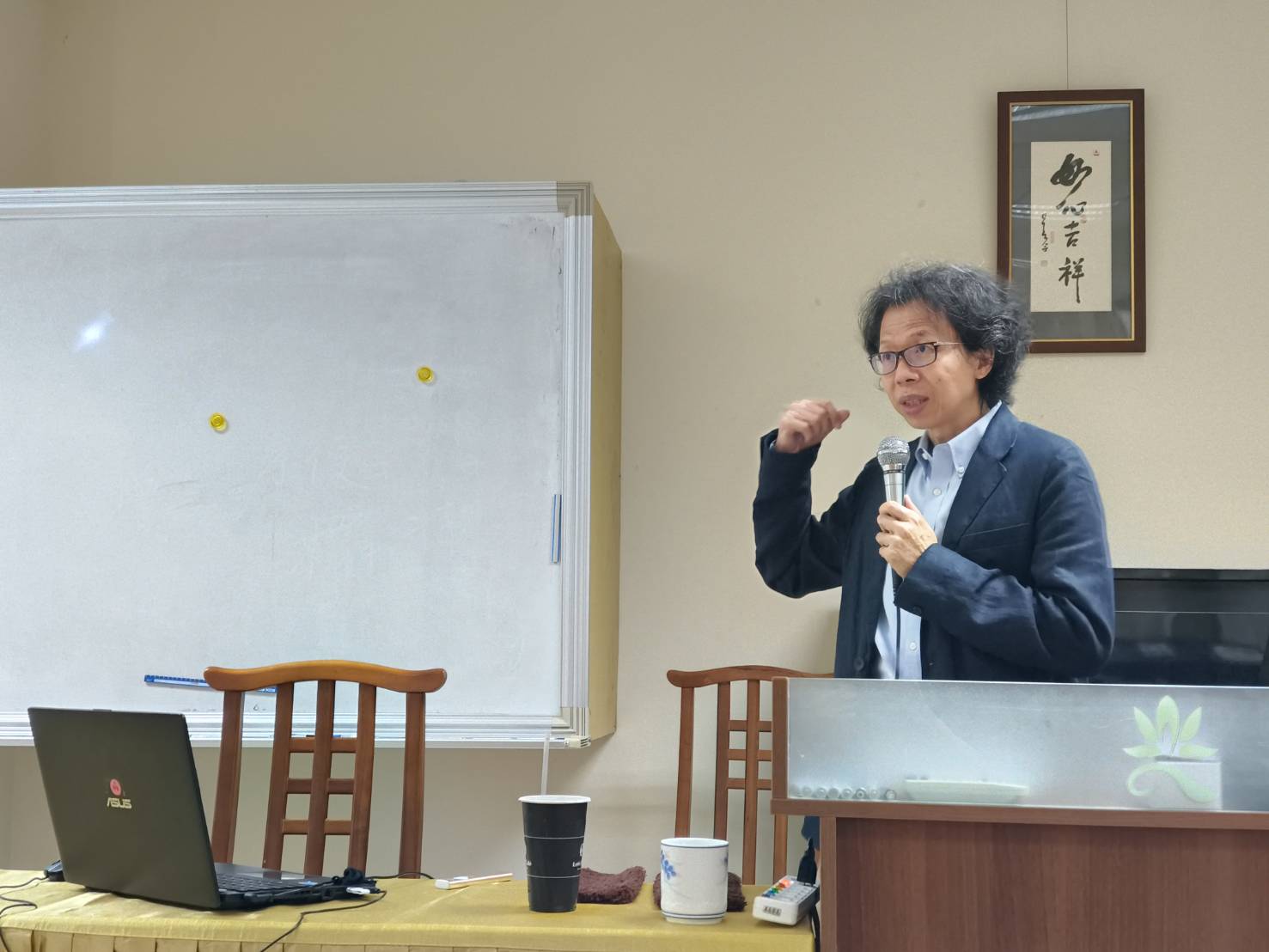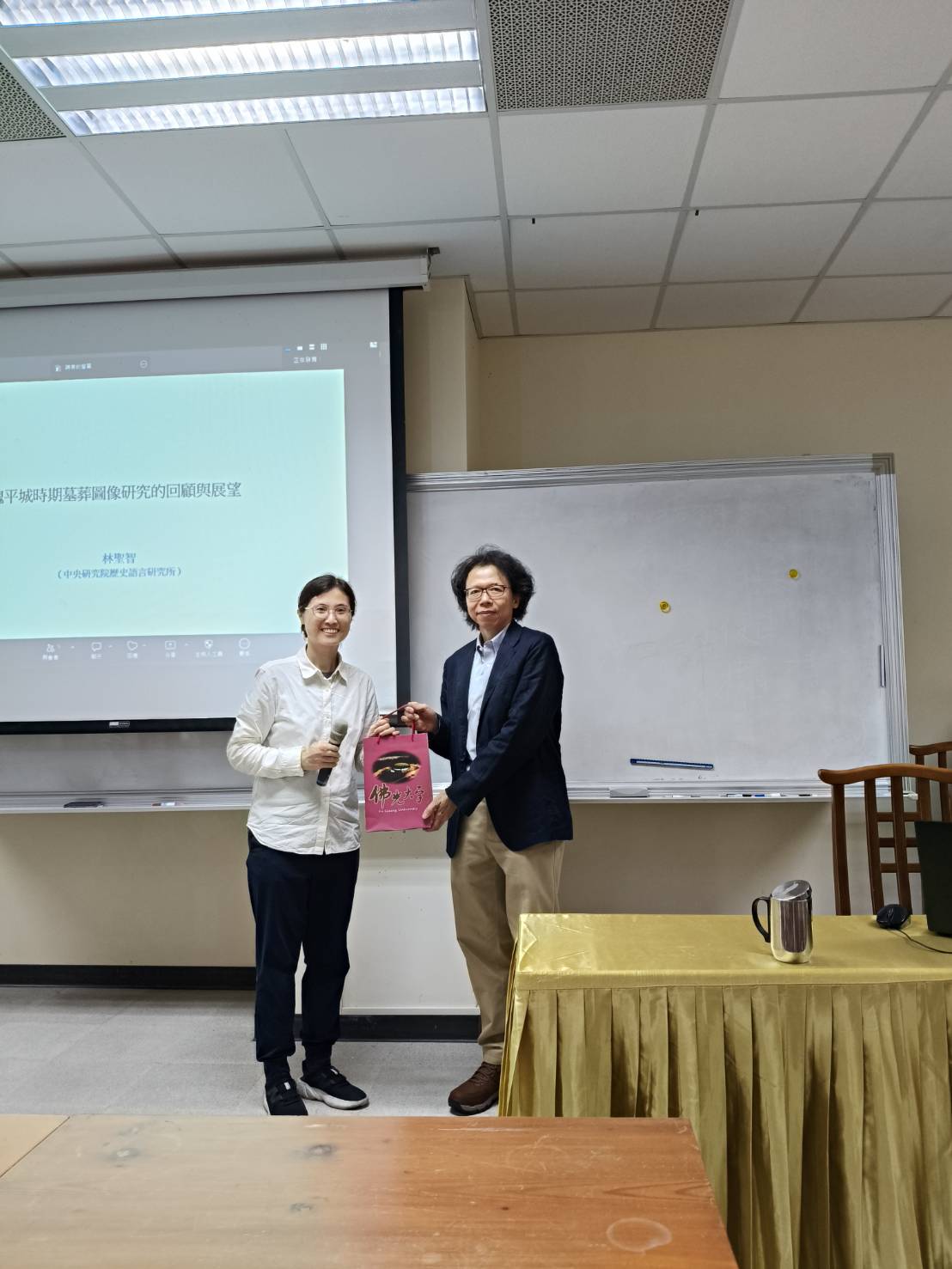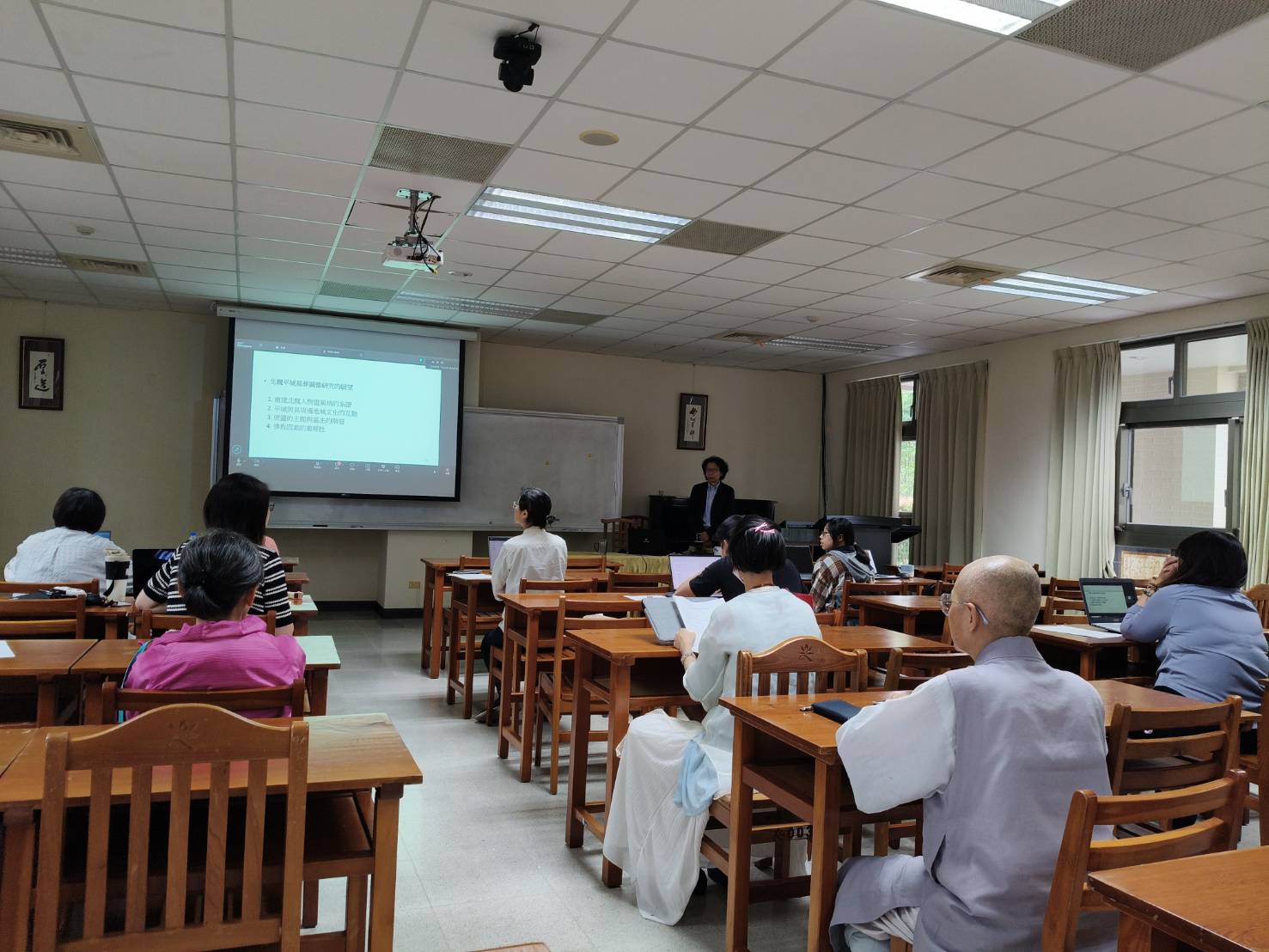
On June 9, 2026, the Center for Buddhist Studies at Fo Guang University held a Buddhist Pedagogy Workshop, inviting Professor Lin Sheng-chih, Research Fellow and Deputy Director of the Institute of History and Philology, Academia Sinica, to deliver a special lecture titled “Research and Prospects on Tomb Images from the Pingcheng Period of the Northern Wei.” The lecture focused on the research history, archaeological materials, visual styles, and Buddhist elements related to tomb images from the Pingcheng period of the Northern Wei.
At the beginning of the lecture, Professor Lin provided a detailed review of scholarship on tomb images from the Pingcheng period. He pointed out that research on this topic may be divided into three major phases. The first phase, from 1965 to 2005, may be described as the stage of “initial discoveries.” During this period, research was primarily based on archaeological findings and the preliminary organization of tomb materials. Important discoveries, such as the Sima Jinlong tomb in Datong, Shanxi, the Northern Wei lacquered coffin tomb in Guyuan, Ningxia, and Northern Wei tomb groups in the Datong area, were gradually excavated and published. These materials drew scholarly attention to the significance of Pingcheng tomb images in the history of Northern Dynasties art.
The second phase, from 2005 to 2017, may be understood as a period marked by the continuous emergence of new materials, including stone burial objects, mural tombs, and tomb groups. During this stage, the scope of research expanded from individual tombs to broader discussions of regional culture, burial systems, and the functions of images. Professor Lin noted that scholarship during this period not only examined the forms and themes of tomb images, but also began to explore the relationships among Buddhist imagery, decorative systems, the identities of tomb occupants, and ethnic culture.
The third phase, from 2017 to 2026, has increasingly focused on integrated studies of Pingcheng and its related regions. Professor Lin explained that recent scholarship no longer treats Pingcheng tomb images as isolated artistic materials. Instead, researchers have placed them within the broader contexts of Northern Wei politics, ethnicity, religion, and regional cultural exchange. This stage of research pays particular attention to Pingcheng’s historical position as the early capital of the Northern Wei, as well as to how the Tuoba Xianbei ruling elite used tomb images, burial objects, and Buddhist elements to express cultural identity and political order.
Before turning to a detailed analysis of images, Professor Lin first reviewed changes in tomb art during the Wei, Jin, and Sixteen Kingdoms periods. He observed that, from the Wei and Jin periods onward, “simple burials” became increasingly common in the Central Plains, gradually transforming the earlier Han tradition of lavish burials, pictorial stones, and mural tombs. However, certain traditions of Eastern Han mural tombs did not disappear entirely. Instead, they were preserved in peripheral regions such as Hexi, Liaodong, and Goguryeo. These regional traditions later became important background for understanding tomb images from the Pingcheng period of the Northern Wei.
Professor Lin further explained that the Pingcheng period of the Northern Wei, roughly from 398 to 493, holds a pivotal position in history. This period not only marked the beginning of a new phase in Northern Dynasties tomb imagery, but also involved questions concerning the identity of the Northern Wei ruling group, the reintegration of regional cultures, and the elevated status of Buddhist images and decorative motifs within tomb spaces. Taking the question “What was the Tuoba Xianbei?” as a point of departure, Professor Lin reminded the audience that the Northern Wei should not be simplified as a single ethnic group or a single culture. Rather, it should be understood as a tribal confederation composed of different nomadic groups, possessing a dual character both as part of North Asian nomadic history and as part of Chinese dynastic history.
During the lecture, Professor Lin introduced a series of important materials, including the Shaling mural tomb in Datong, Shanxi; the Xie Xing stone chamber; the Zhang Zhilang stone chamber; the Song Shaozu stone sarcophagus; the Sima Jinlong tomb; the Yonggu Mausoleum at Fangshan; and the Northern Wei lacquered coffin tomb in Guyuan, Ningxia. Among these, the Shaling mural tomb, dated to the first year of the Taiyan reign of Emperor Taiwu of the Northern Wei, or 435 CE, is one of the earliest known dated mural tombs of the Northern Wei. Using this example, Professor Lin raised a crucial question: should these tomb images be understood as a continuation of Han mural traditions, or as the beginning of a new form of Northern Dynasties tomb imagery?
In terms of image content, Professor Lin analyzed the visual combinations found in mural tombs, stone chambers, stone sarcophagi, and lacquered coffins, including saddled horses, ox carts, mythical beasts, Fuxi and Nüwa, the Queen Mother of the West, the King Father of the East, donors, monks, and Buddhist themes. He emphasized that Pingcheng tomb images were not merely a simple continuation of Han pictorial traditions. Rather, they formed a new visual language through multiple layers of cultural interaction. In particular, the appearance of Buddhist imagery in tombs shows that Buddhism was not only present as a religious belief, but also gradually became an important component of tomb space, the imagined world of the deceased, and the expression of social and cultural identity.
Professor Lin also paid special attention to the importance of Buddhist elements. He pointed out that, during the Pingcheng period of the Northern Wei, Buddhist imagery and ornamentation were not merely secondary religious symbols. Instead, they acquired a new position within the visual system of tombs. For example, images of monks, donors, and incense burners on stone chambers reflect the integration of Buddhist ritual, the concept of offering, and funerary culture. As a result, Northern Wei tomb images have become important materials for understanding medieval Buddhist art, burial practices, and broader social and cultural transformations.
At the end of the lecture, Professor Lin proposed several directions for future research on tomb images from the Pingcheng period of the Northern Wei. First, scholars may further reconstruct the stylistic genealogy of Northern Wei figure painting. Second, future studies may examine the interactions between Pingcheng and its surrounding regional cultures. Third, the relationship between mural themes and the social status of tomb occupants deserves further analysis. Fourth, the significance of Buddhist elements in Northern Wei tomb images should be reassessed. Through these directions, the study of Pingcheng tomb images can not only enrich the history of Northern Dynasties art, but also contribute to the study of Buddhist history, ethnic history, funerary culture, and visual culture in medieval China. The lecture was rich in content and insight. Through a clear review of scholarship, detailed image analysis, and a broad historical perspective, Professor Lin guided the students to reconsider the academic value of tomb images from the Pingcheng period of the Northern Wei.