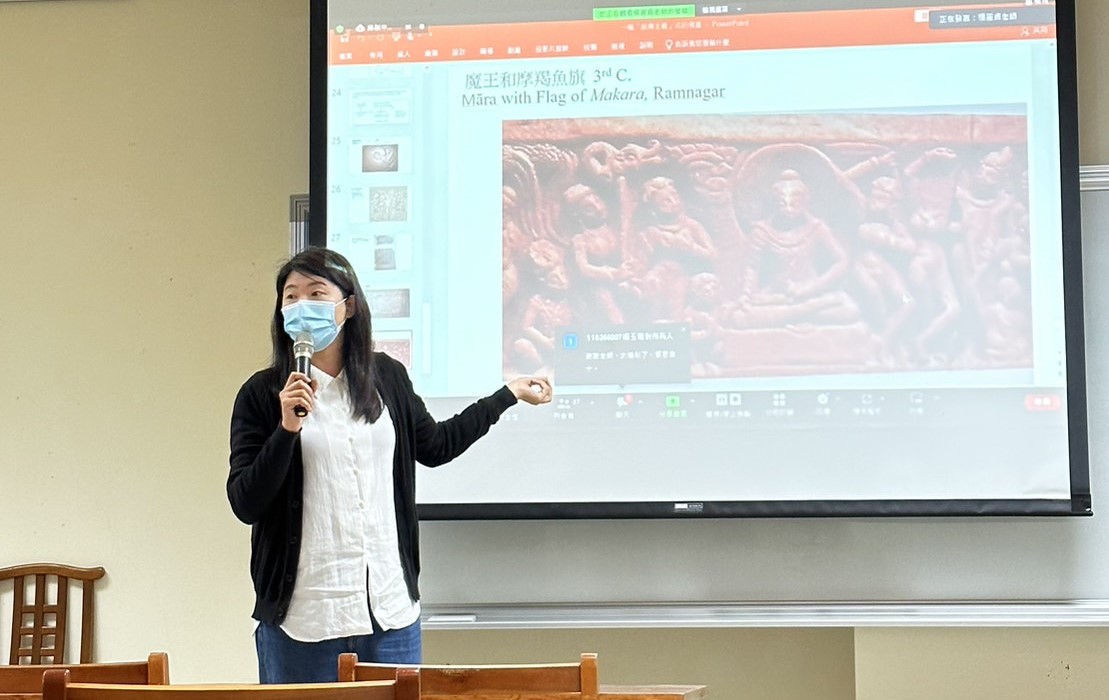
For the "Buddhist Teaching Workshop" of the 112th Academic Year*, the Fo Guang University Center for Buddhist Studies invited Dr. Yang Li-chen, a Ph.D. in Art History and Theory from the School for Advanced Studies in the Social Sciences (EHESS) in Paris. On March 29, 2023, Dr. Yang visited the College of Buddhist Studies to deliver a lecture titled "A 'Structuralist' Buddhist Painting: The Guimet Museum Collection’s The Assault of Mara (MG. 17655)." The session was introduced by Assistant Professor Guo Feng-yan of the Department of Buddhist Studies, with approximately 60 faculty members and students attending either in person or online.
The lecture focused on the silk painting The Assault of Mara (Accession No. MG. 17655), housed in the Guimet National Museum of Asian Arts in Paris. The painting is composed of three distinct sections: the central main panel, two side panels, and a bottom horizontal panel (predella).
Dr. Yang explained that for the past century, the academic community has customarily interpreted the work solely through the central theme of "The Assault of Mara" (Mara’s attack and the Buddha’s enlightenment). Knowledge regarding the overall significance of how the other two sections combine with the center has remained limited. She argued that to solve the riddle of MG. 17655, one should not be satisfied with the general narrative of "The Assault of Mara." Instead, research should be expanded into scriptural meanings to find the answer.
Applying the theories of Structuralism from the 1970s—specifically focusing on internal relations, implication, and contrast—Dr. Yang’s analysis revealed that over a dozen texts on the Acts of the Buddha share a common three-point structure. These texts separately narrate three types of virtues/powers corresponding to three periods: before the Buddha’s enlightenment, the moment of enlightenment, and after enlightenment.
Dr. Yang concluded that the imagery in the three sections of this painting corresponds exactly to these three different timeframes and essential virtues. In her lecture, she termed them:
-
The Virtue of the Seven Treasures (Pre-enlightenment)
-
The Virtue of Wisdom in Subduing Mara (The moment of Enlightenment)
-
The Virtue of Supernatural Powers (Post-enlightenment)
Expressing these three aspects of the Buddha’s virtues constitutes the complete and integral meaning of MG. 17655.